Unlock Thousands: How an Extra $50 Monthly Slashes Debt by 2029
The True Cost of Minimum Payments: How an Extra $50 Monthly Can Save You Thousands by 2029
In the intricate world of personal finance, few concepts are as deceptively simple yet profoundly impactful as the minimum payment. For many, it represents a sigh of relief – a manageable sum that keeps creditors at bay and avoids late fees. However, beneath this apparent simplicity lies a hidden cost, a silent killer of financial aspirations: prolonged debt and exorbitant interest charges. The conventional wisdom of merely meeting minimum obligations can trap individuals in a seemingly endless cycle, turning a manageable debt into a lifelong burden. But what if a small, consistent adjustment could fundamentally alter this trajectory? What if an extra $50 monthly payment could be the key to unlocking thousands in savings and accelerating your journey to financial freedom by 2029?
This article delves deep into the transformative power of consistently paying an extra $50 monthly towards your outstanding debt. We’re not just talking about minor adjustments; we’re exploring a strategy that, while seemingly small, possesses the compounding potential to save you a significant fortune in interest and shave years off your repayment timeline. By understanding the mechanics of interest, the pitfalls of minimum payments, and the strategic advantages of even a modest increase, you’ll gain the insights and motivation needed to reclaim control over your finances. Prepare to uncover how this seemingly insignificant change can become your most powerful tool in the fight against debt, paving the way for a more secure and prosperous financial future within the next five years.
Understanding the Trap of Minimum Payments
To truly appreciate the impact of an extra $50 monthly, it’s crucial to first understand the nature of minimum payments. Credit card companies and lenders structure these payments to be as low as possible, often just 1-3% of your outstanding balance, plus interest. While this makes debt seem affordable in the short term, it’s a cunning strategy designed to maximize the amount of interest you pay over the life of the loan. The vast majority of your minimum payment, especially in the early stages of repayment, goes directly towards interest, leaving very little to chip away at the principal balance.
Consider a typical credit card debt of $5,000 with an annual percentage rate (APR) of 18%. If your minimum payment is 2% of the balance, you’d initially pay $100. However, a significant portion of that $100 is interest. As your balance slowly decreases, so does your minimum payment, meaning you’re paying less and less towards the principal each month. This creates a vicious cycle where debt persists for years, sometimes decades, costing you thousands more than the original amount borrowed. This is the insidious trap that an extra $50 monthly aims to dismantle.
The Compounding Effect of Interest
Interest isn’t just a flat fee; it compounds. This means that interest is calculated not only on your original principal but also on the accumulated interest from previous periods. When you only make minimum payments, this compounding works against you, causing your debt to grow at an alarming rate even if you don’t incur new charges. Conversely, when you pay an extra $50 monthly, you’re reducing the principal balance faster, which in turn reduces the base on which future interest is calculated. This allows the power of compounding to start working for you, not against you, accelerating your debt payoff significantly.
The Power of an Extra $50 Monthly: A Detailed Scenario
Let’s illustrate the profound impact of an extra $50 monthly with a concrete example. Imagine you have a credit card debt of $5,000 at an 18% APR. Your minimum payment is 2% of the balance. Without any additional payments, you could be looking at:
- Total Repayment Time: Approximately 15-20 years (or even more, depending on the exact minimum payment formula and if new charges are avoided).
- Total Interest Paid: Easily exceeding $4,000 – $5,000, effectively doubling the original debt.
- Total Amount Paid: $9,000 – $10,000.
Now, let’s introduce the game-changer: an extra $50 monthly payment. Instead of just paying the minimum, you commit to paying an additional $50 on top of it. For our $5,000 debt at 18% APR, let’s assume an initial minimum payment of $100 (2% of $5,000).
Scenario 1: Minimum Payments Only
If you stick to minimum payments, the repayment journey is long and costly. For a $5,000 debt at 18% APR with a 2% minimum payment, it could take over 15 years to pay off, costing you upwards of $4,500 in interest alone. Your total outlay would be around $9,500.
Scenario 2: Adding an Extra $50 Monthly
By consistently paying an extra $50 monthly, your payment becomes $150 ($100 minimum + $50 extra). The results are astonishing:
- Total Repayment Time: Reduced to approximately 4-5 years.
- Total Interest Paid: Drops significantly to around $1,000 – $1,200.
- Total Amount Paid: Approximately $6,000 – $6,200.
This means that by simply adding an extra $50 monthly, you could:
- Save thousands of dollars in interest: Potentially $3,000 – $3,500 in this single scenario.
- Become debt-free over a decade sooner: Freeing up significant cash flow for other financial goals.
This isn’t just theoretical; it’s a mathematical certainty. Every dollar of the extra $50 monthly goes directly to reducing your principal balance, which in turn reduces the interest charged in subsequent months. This creates a powerful snowball effect that accelerates your debt payoff exponentially.
Strategies to Find Your Extra $50 Monthly
The idea of finding an extra $50 monthly might seem daunting, especially if your budget already feels stretched thin. However, it’s often more achievable than you think. Small adjustments, when consistently applied, can free up the necessary funds without drastically altering your lifestyle.
Budgeting and Tracking Expenses
The first step is always to understand where your money is going. Create a detailed budget, tracking every dollar you spend for at least a month. You might be surprised at how much accumulates from seemingly small, discretionary purchases. Tools like budgeting apps (e.g., Mint, YNAB) or even a simple spreadsheet can be incredibly helpful.
Cutting Discretionary Spending
Once you have a clear picture of your spending, identify areas where you can trim. Could you:
- Reduce eating out by one meal a week?
- Cut down on daily coffee shop visits?
- Review and cancel unused subscriptions (streaming services, gym memberships, apps)?
- Opt for generic brands over name brands at the grocery store?
- Bring lunch from home a few more times a week?
Often, just one or two of these small changes can easily free up an extra $50 monthly.
Finding Small Income Boosts
If cutting expenses isn’t enough, consider ways to boost your income slightly. This doesn’t necessarily mean a second job:
- Sell unused items around your house (clothing, electronics, furniture) on platforms like eBay, Facebook Marketplace, or local consignment shops.
- Pick up a few hours of freelance work or gig economy tasks (e.g., dog walking, delivery services, online surveys).
- Ask for a small raise or take on additional responsibilities at your current job.
- Review your credit card rewards – sometimes cashback can be applied as a statement credit.
The goal is simply to find that consistent extra $50 monthly to dedicate to your debt.
Implementing Your Debt Payoff Strategy: Snowball vs. Avalanche
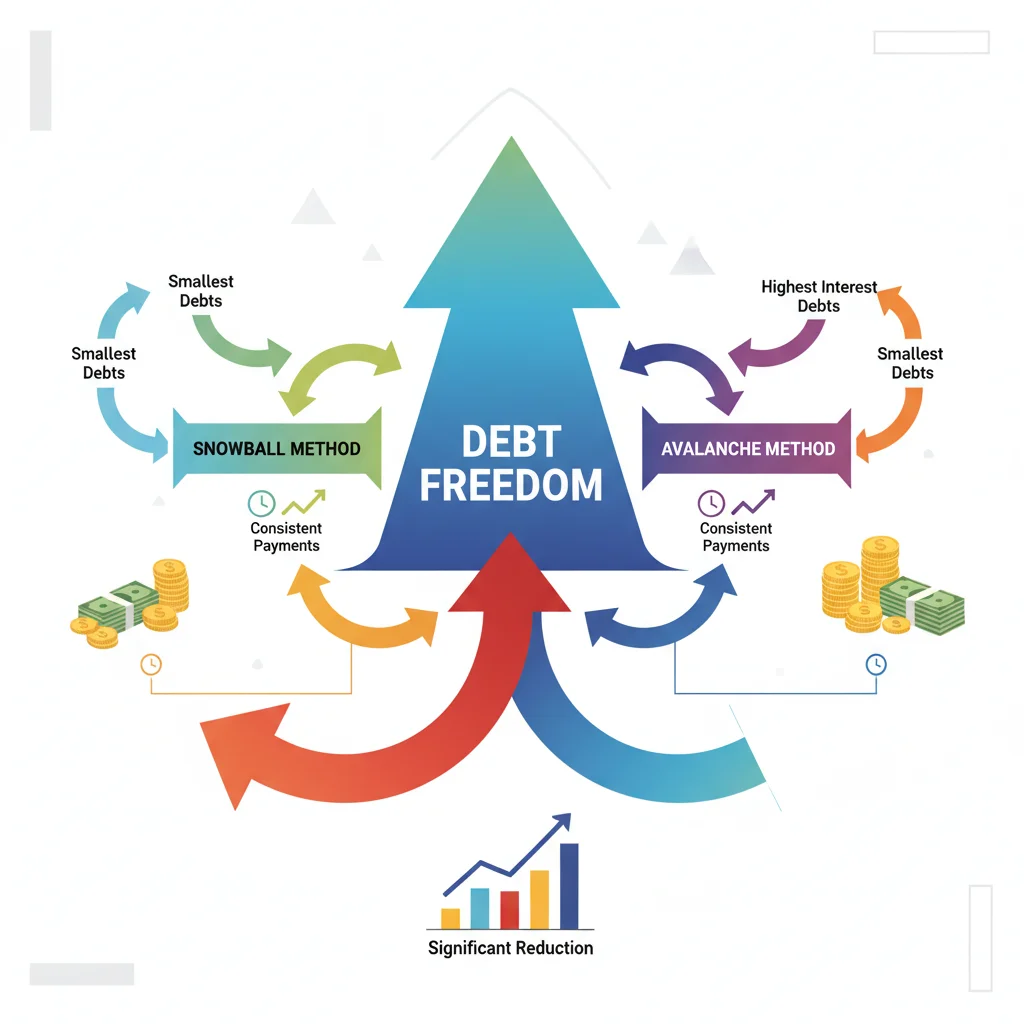
Once you’ve secured your extra $50 monthly, the next step is to strategically apply it. There are two popular and highly effective debt payoff methods: the debt snowball and the debt avalanche. Both leverage the power of extra payments, but they differ in their approach.
Debt Snowball Method
The debt snowball method focuses on psychological wins. You list all your debts from smallest balance to largest, regardless of interest rate. You make minimum payments on all debts except the smallest one, to which you apply your extra $50 monthly (and any other extra funds). Once the smallest debt is paid off, you take the money you were paying on that debt (minimum payment + your extra $50 monthly) and add it to the minimum payment of the next smallest debt. This creates a growing ‘snowball’ of payments, building momentum and motivation as you eliminate debts one by one. While it might cost slightly more in interest than the avalanche method, the psychological boost of quick wins can be invaluable for staying motivated.
Debt Avalanche Method
The debt avalanche method is mathematically the most efficient. You list all your debts from highest interest rate to lowest. You make minimum payments on all debts except the one with the highest interest rate, to which you apply your extra $50 monthly. Once that debt is paid off, you take the money you were paying on it (minimum payment + your extra $50 monthly) and apply it to the debt with the next highest interest rate. This method saves you the most money in interest over time, as you’re tackling the most expensive debts first. If you’re disciplined and motivated by financial optimization, the avalanche method is often the preferred choice.
Regardless of which method you choose, the key is consistency. Committing to that extra $50 monthly and applying it strategically will yield significant results. For many, a combination of both approaches, or starting with the snowball for quick wins then switching to the avalanche, can also be effective.
Beyond Credit Cards: Applying the Extra $50 Monthly to Other Debts
The principle of making an extra $50 monthly payment isn’t limited to credit card debt. Its power extends to various forms of debt, offering substantial savings and accelerated payoff across the board.
Personal Loans
Personal loans often come with fixed interest rates and repayment schedules. Adding an extra $50 monthly can significantly reduce the total interest paid and shorten the loan term. For example, a $10,000 personal loan at 10% APR over 5 years might have a monthly payment of around $212. Adding $50 to make it $262 per month could shave off nearly a year from the repayment period and save you hundreds in interest.
Student Loans
Student loans, especially federal ones, often have flexible repayment options. However, making only minimum payments can mean decades of debt. An extra $50 monthly applied to a student loan can cut years off your repayment schedule and save you thousands. For instance, a $30,000 student loan at 6% interest over 10 years has a payment of about $333. Adding $50 to make it $383 could reduce the repayment time by over a year and a half and save you over $1,500 in interest.
Auto Loans
While auto loans typically have lower interest rates than credit cards, they are still a significant debt. An extra $50 monthly payment can reduce the total interest paid and help you own your car outright sooner. This is particularly beneficial if you’re looking to upgrade vehicles in the future or simply want to eliminate a monthly expense from your budget.
The consistent application of an extra $50 monthly is a universal principle for debt reduction. It works because it directly attacks the principal, reducing the base for interest calculations and leveraging the power of compounding in your favor, no matter the type of debt.
The Long-Term Financial Benefits by 2029 and Beyond
The immediate savings from an extra $50 monthly are compelling, but the long-term benefits, especially looking towards 2029, are truly transformative. Imagine being completely debt-free by 2029, or significantly reducing your debt burden, all thanks to this consistent effort.
Increased Cash Flow
Once your debts are paid off, the money you were allocating to payments (including that extra $50 monthly) is now freed up. This increased cash flow can be directed towards other crucial financial goals:
- Emergency Fund: Build a robust emergency fund (3-6 months of living expenses) to protect yourself from unforeseen financial shocks.
- Investments: Start or increase contributions to retirement accounts (401k, IRA) or other investment vehicles. The earlier you start investing, the more time your money has to grow through compounding.
- Down Payment: Save for a down payment on a house, car, or other significant purchase.
- Education: Fund your own education or that of your children.
- Financial Freedom: Simply enjoy more disposable income without the stress of debt.
Improved Credit Score
Consistently paying more than the minimum, especially on revolving credit like credit cards, demonstrates responsible financial behavior. This can lead to a lower credit utilization ratio (the amount of credit you’re using compared to your total available credit), which is a major factor in your credit score. A higher credit score can translate to lower interest rates on future loans (mortgages, auto loans) and better terms on other financial products, saving you even more money in the long run.
Reduced Financial Stress
Perhaps one of the most significant, yet often overlooked, benefits is the reduction in financial stress. Debt can be a heavy emotional burden, impacting mental health, relationships, and overall well-being. By actively taking control and making an extra $50 monthly payment, you’re not just saving money; you’re investing in your peace of mind and building a foundation for a less stressful future.
By 2029, the cumulative effect of an extra $50 monthly could mean the difference between still struggling with debt and enjoying substantial financial freedom, with a healthy savings account and investments growing for your future.

Maintaining Momentum and Avoiding Pitfalls
Committing to an extra $50 monthly is a fantastic start, but maintaining that momentum and avoiding common pitfalls is key to achieving your debt-free goals by 2029. Consistency and discipline are your greatest allies.
Automate Your Payments
The easiest way to ensure you consistently pay an extra $50 monthly is to automate it. Set up an automatic payment with your bank or credit card company for the higher amount. This removes the need to remember each month and reduces the chances of missing a payment or reverting to the minimum. Automation ensures your strategy remains on track.
Resist New Debt
While you’re aggressively paying down existing debt with your extra $50 monthly, it’s crucial to avoid incurring new debt. This can be challenging, but it’s essential for your progress. If possible, put away your credit cards or use them only for essential purchases that you can pay off in full each month. Focus on living within your means and distinguishing between needs and wants.
Celebrate Milestones
Paying off debt can be a long journey. Celebrate small victories along the way to stay motivated. Whether it’s paying off your first small debt using the snowball method, reaching a certain percentage of total debt paid, or simply making 12 consecutive extra $50 monthly payments, acknowledge your progress. These small celebrations don’t have to be expensive; they can be a nice meal at home or a guilt-free movie night.
Stay Flexible and Review Your Budget
Life happens, and your financial situation might change. Your budget isn’t set in stone. Periodically review your income and expenses. If you get a raise, consider increasing your extra payment even further. If an unexpected expense arises, temporarily adjust your budget to accommodate it without completely derailing your debt payoff plan. The goal is progress, not perfection.
Seek Professional Advice if Needed
If your debt feels overwhelming, or if you’re struggling to find that extra $50 monthly, don’t hesitate to seek professional help. Non-profit credit counseling agencies can offer guidance, help you create a debt management plan, or explore other options like debt consolidation or balance transfers. There’s no shame in asking for assistance when navigating complex financial situations.
Conclusion: Your Path to Financial Freedom by 2029
The journey to financial freedom often seems daunting, fraught with complex strategies and seemingly insurmountable numbers. However, as we’ve explored, the path can begin with a remarkably simple, yet profoundly powerful, step: consistently paying an extra $50 monthly towards your debt. This small adjustment, when applied strategically, is not merely an incremental payment; it’s an investment in your future, a catalyst for significant change that can save you thousands of dollars in interest and shave years off your repayment timeline.
By understanding the deceptive nature of minimum payments, leveraging the power of compounding in your favor, and implementing a consistent debt payoff strategy, you are actively taking control of your financial destiny. Whether you choose the motivational boost of the debt snowball or the mathematical efficiency of the debt avalanche, the consistent application of that extra $50 monthly is the engine that drives your progress.
Imagine the possibilities by 2029: substantial debt reduction, increased cash flow, a healthier credit score, and a significant reduction in financial stress. These are not distant dreams but tangible outcomes achievable through disciplined action. It’s a testament to the idea that small, consistent efforts can yield monumental results. Start today. Find that extra $50 monthly. Commit to the process. Your future self, free from the shackles of debt and poised for greater financial prosperity, will undoubtedly thank you for it.