Debt Avalanche Method: Pay Off Debt Faster

The Debt Avalanche Method: Your Fastest Route to Financial Freedom
Are you drowning in debt, feeling like you’re stuck on a treadmill that never stops? Do you dream of a life free from the burden of monthly payments and the stress of high-interest rates? You’re not alone. Millions of people grapple with debt, from credit cards to student loans, and finding an effective strategy to tackle it can feel overwhelming. But what if there was a proven method that could not only help you pay off your debt faster but also save you a significant amount of money in interest?
Enter the debt avalanche method. This powerful financial strategy is designed to systematically eliminate your debt by focusing on the accounts with the highest interest rates first. Unlike other methods that prioritize smallest balances, the debt avalanche method is a mathematically superior approach that optimizes your payments to minimize the total interest paid over time. In this comprehensive guide, we’ll delve deep into the intricacies of the debt avalanche method, explain why it’s so effective, and provide a step-by-step roadmap to implement it in your own financial life. Get ready to accelerate your journey to financial freedom and reclaim control of your money!
Understanding the Debt Avalanche Method: A Strategic Overview
At its core, the debt avalanche method is a debt reduction strategy where you prioritize paying off your debts in order of their interest rates, from highest to lowest. Here’s how it works in practice:
- List all your debts: Start by gathering all your debt information. This includes credit cards, personal loans, student loans, car loans, and any other outstanding balances.
- Order by interest rate: For each debt, identify its annual percentage rate (APR). Then, arrange your debts from the one with the highest interest rate to the one with the lowest.
- Make minimum payments on all but one: For all your debts except the one with the highest interest rate, make only the minimum required payment.
- Attack the highest interest debt: Direct any extra money you have towards the debt with the highest interest rate. This ‘extra money’ could come from budgeting adjustments, side hustles, bonuses, or tax refunds.
- Snowball your payments: Once the highest interest debt is completely paid off, take the money you were paying on that debt (both the minimum payment and any extra funds) and add it to the minimum payment of the next debt on your list (which now has the highest remaining interest rate). You continue this process, ‘avalanching’ your payments from one debt to the next until all your debts are gone.
The beauty of the debt avalanche method lies in its mathematical efficiency. By eliminating the debts that accrue the most interest first, you significantly reduce the total amount of interest you’ll pay over the lifetime of your debts. This not only saves you money but also shortens your overall debt payoff timeline.
Why Choose the Debt Avalanche Method Over Other Strategies?
While several debt payoff strategies exist, such as the debt snowball method, the debt avalanche method stands out for its financial benefits. Let’s compare it to its most common counterpart:
Debt Avalanche vs. Debt Snowball: The Key Difference
- Debt Avalanche: Prioritizes debts by highest interest rate first.
- Debt Snowball: Prioritizes debts by smallest balance first.
The debt snowball method focuses on psychological wins. By paying off smaller debts quickly, it provides a sense of accomplishment and motivation to continue. While this can be effective for some, it often means you’re paying more interest in the long run because you might be ignoring larger debts with higher interest rates. The debt avalanche method, on the other hand, is purely mathematical. It focuses on the most expensive debts first, which directly translates to less money spent on interest and a faster path to debt freedom.
Consider two debts: one with a balance of $1,000 and an APR of 25%, and another with a balance of $5,000 and an APR of 10%. With the debt snowball, you’d tackle the $1,000 debt first. With the debt avalanche method, you’d prioritize the $1,000 debt because its 25% APR is significantly higher than the 10% APR on the $5,000 debt, even though its balance is smaller. This strategic focus saves you more money.
Step-by-Step Guide to Implementing the Debt Avalanche Method
Ready to put the debt avalanche method into action? Follow these detailed steps to set yourself up for success:
Step 1: Gather All Your Debt Information
The first crucial step is to get a complete and accurate picture of all your outstanding debts. This means:
- Identify all debts: List every loan, credit card, and bill you owe. Don’t forget store credit cards, medical bills, or personal loans from family or friends if they have interest attached.
- Note the current balance: For each debt, write down the exact outstanding balance.
- Find the interest rate (APR): This is arguably the most critical piece of information for the debt avalanche method. Check your statements, online accounts, or call your lenders if you’re unsure. Be sure to use the Annual Percentage Rate (APR), not just a monthly rate.
- Record minimum monthly payment: Know what you’re currently obligated to pay each month for each debt.
Organize this information in a spreadsheet or a simple table. This visual representation will be incredibly helpful for tracking your progress.
Step 2: Order Your Debts by Interest Rate
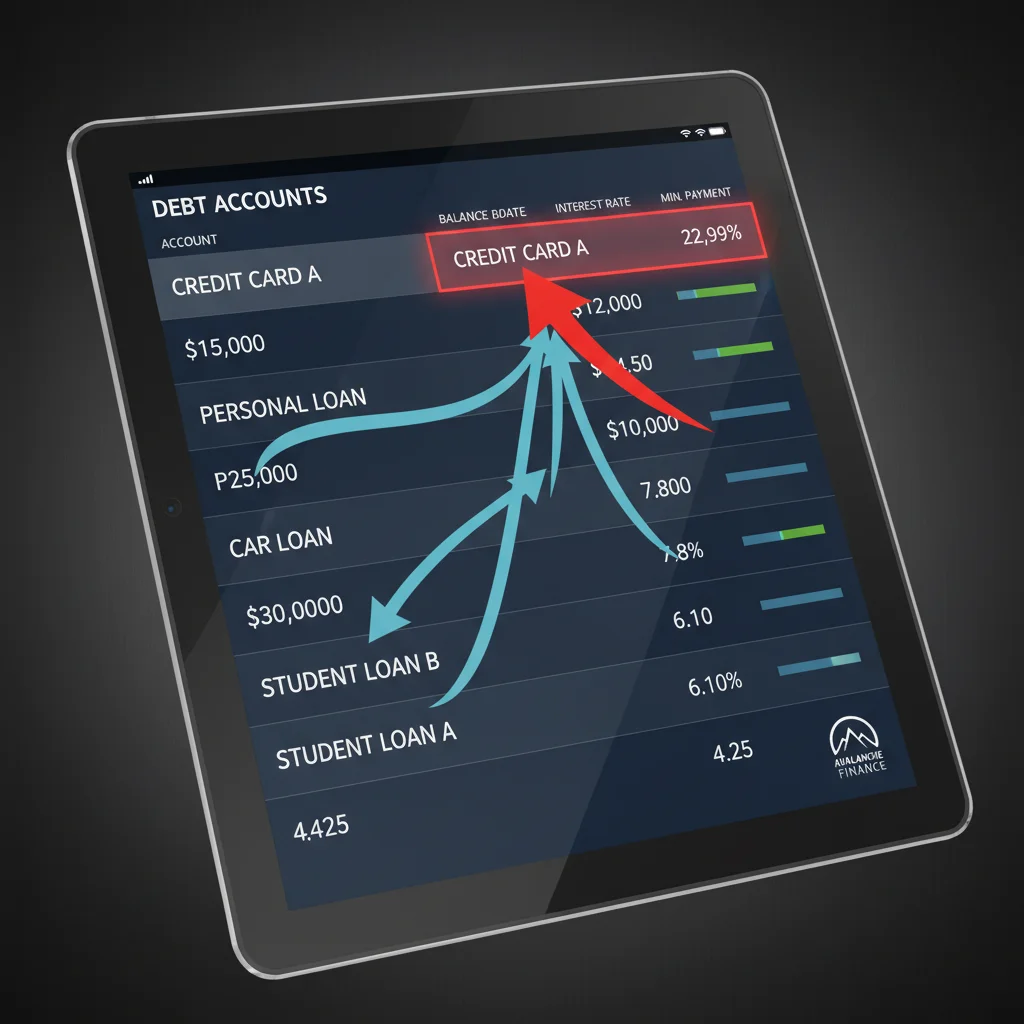
Once you have all your debt information, arrange them from the highest interest rate to the lowest. This sorted list is your action plan for the debt avalanche method. For example:
| Debt | Current Balance | Interest Rate (APR) | Minimum Payment |
|---|---|---|---|
| Credit Card A | $3,000 | 24.99% | $75 |
| Personal Loan | $5,000 | 18.00% | $150 |
| Credit Card B | $2,000 | 19.99% | $60 |
| Student Loan | $10,000 | 6.8% | $110 |
| Car Loan | $12,000 | 4.5% | $220 |
In this example, Credit Card A (24.99%) would be your first target, followed by Credit Card B (19.99%), then the Personal Loan (18.00%), and so on. Note that the example table above is for illustrative purposes only. Always use your actual interest rates.
Step 3: Create a Realistic Budget
To effectively use the debt avalanche method, you need to find extra money to put towards your highest interest debt. This requires a solid budget. Track your income and expenses meticulously for a month or two to understand where your money is going. Look for areas where you can cut back, even temporarily. Common areas include:
- Dining out less frequently
- Canceling unused subscriptions
- Reducing entertainment expenses
- Finding cheaper alternatives for groceries or transportation
Every dollar you free up is a dollar you can put towards accelerating your debt payoff.
Step 4: Make Minimum Payments on All Debts Except the Top One
This is where the action begins. For all debts on your list, except for the very first one (your highest interest rate debt), make only the minimum required payment each month. This ensures you avoid late fees and maintain good standing with your creditors.
Step 5: Attack the Highest Interest Debt with Everything You’ve Got
Now, take all the extra money you’ve freed up in your budget and add it to the minimum payment of your highest interest rate debt. This aggressive approach is what makes the debt avalanche method so powerful. For instance, if your minimum payment on Credit Card A was $75, and you found an extra $100 in your budget, you would pay $175 towards Credit Card A that month. The more you can contribute, the faster that debt will disappear.
Step 6: Repeat and Roll Your Payments
Continue making minimum payments on all other debts and aggressively attacking your top-priority debt until it is completely paid off. This is a moment to celebrate! Once that debt is gone, you don’t just stop paying that extra money. Instead, you take the entire amount you were paying on the now-eliminated debt (its minimum payment + any extra funds you were contributing) and add it to the minimum payment of the next debt on your prioritized list (which now has the highest remaining interest rate).
This is the ‘avalanche’ effect. Your payments grow larger and larger as each debt is eliminated, allowing you to tackle subsequent debts even faster. This momentum helps you maintain motivation while optimizing your financial savings.
Maximizing Your Debt Avalanche: Advanced Tips and Strategies
While the core principles of the debt avalanche method are straightforward, there are additional strategies you can employ to supercharge your progress:
Consider Debt Consolidation or Refinancing for Lower Rates
If you have multiple high-interest debts, especially credit card balances, exploring debt consolidation or refinancing options could be beneficial. A debt consolidation loan or a balance transfer credit card (with a 0% introductory APR) could potentially lower your overall interest rate, making your debt avalanche method even more effective. However, be cautious:
- Balance Transfer Cards: Ensure you can pay off the balance before the introductory APR expires, or you could end up with a higher rate.
- Consolidation Loans: Make sure the new interest rate is genuinely lower than your existing debts, and be wary of fees.
If you consolidate, the new consolidated loan or credit card effectively becomes your new highest-interest debt (or one of them), and you’d apply the debt avalanche method to it.
Increase Your Income
The more money you can throw at your debts, the faster they’ll disappear. Consider ways to boost your income:
- Side Hustles: Freelancing, ride-sharing, dog walking, or selling crafts online.
- Overtime at Work: If available and feasible.
- Selling Unused Items: Declutter your home and make some extra cash.
- Negotiate a Raise: If you’ve been performing well at your job.
Every additional dollar earned can be directed straight to your top-priority debt.
Automate Payments to Stay Consistent
Set up automatic payments for at least the minimum amounts on all your debts. For your top-priority debt, automate the minimum payment, and then make a separate, manual payment of your extra funds. This ensures you never miss a payment and avoid late fees, which can derail your progress and add to your debt burden. Consistency is key to the success of the debt avalanche method.
Track Your Progress Regularly
Seeing your balances decrease can be incredibly motivating. Use a spreadsheet, a budgeting app, or even a simple pen and paper to track your debt balances monthly. Watching that highest-interest debt shrink will reinforce your commitment to the debt avalanche method and keep you focused on your goal of becoming debt-free.

Common Challenges and How to Overcome Them
While the debt avalanche method is highly effective, the journey to debt freedom isn’t always smooth. You might encounter challenges, but with foresight and planning, you can overcome them.
Lack of Extra Funds
Challenge: You’ve budgeted, but there simply isn’t much extra money to put towards your debt beyond minimum payments.
Solution: This is a common hurdle. Revisit your budget with a fine-tooth comb. Are there any ‘wants’ you can temporarily cut out? Even small amounts add up. Consider temporary income-boosting strategies like selling items you no longer need, taking on a small side gig, or even temporarily reducing your retirement contributions (though this should be a last resort and carefully considered). Remember, even a small extra payment using the debt avalanche method is better than none and will still save you money compared to just making minimums.
Loss of Motivation
Challenge: The highest interest debt might also be a large balance, and it can take a long time to see significant progress, leading to discouragement.
Solution: Set smaller, achievable milestones. Instead of focusing solely on paying off the entire debt, aim to reduce it by a certain percentage each month, or pay an extra $50 for three months straight. Celebrate these small victories. Keep a visual tracker, like a thermometer chart, to mark your progress. Remind yourself of the long-term savings the debt avalanche method provides. If motivation truly wanes, you might temporarily switch to a hybrid approach, incorporating a small ‘snowball’ win to boost morale, then returning to the avalanche.
Unexpected Expenses
Challenge: Life happens. A car repair, medical emergency, or job loss can derail your debt payoff plan.
Solution: This highlights the importance of an emergency fund. Before aggressively tackling debt, aim to save at least $1,000 (or one month’s essential expenses) in an easily accessible savings account. This ‘mini-emergency fund’ acts as a buffer against life’s curveballs, preventing you from accumulating more debt when unexpected costs arise. If you don’t have one, consider pausing extra debt payments temporarily to build this fund first. Once built, you can resume the debt avalanche method with greater security.
Credit Card Temptation
Challenge: It’s easy to fall back into old spending habits, especially if you’ve paid off a credit card only to rack up new charges.
Solution: Address the root cause of your spending. Are you an emotional spender? Do you use credit cards for convenience without tracking? Consider cutting up or freezing credit cards you’ve paid off (or are actively paying off) to remove the temptation. Stick strictly to your budget and use cash or a debit card for everyday purchases. The goal of the debt avalanche method is not just to pay off debt, but to change your financial habits for good.
The Long-Term Benefits of Embracing the Debt Avalanche Method
Successfully implementing the debt avalanche method isn’t just about paying off debt; it’s about transforming your financial future. The benefits extend far beyond simply having zero balances:
- Significant Interest Savings: As discussed, this is the primary financial advantage. By eliminating high-interest debts first, you save potentially thousands of dollars that would otherwise go to creditors. This money stays in your pocket, free to be used for savings, investments, or other financial goals.
- Faster Debt Freedom: The mathematical efficiency of the debt avalanche method means you’ll typically become debt-free faster than with other methods, assuming you stick to the plan.
- Improved Credit Score: As you pay down your debts, especially revolving credit like credit cards, your credit utilization ratio (the amount of credit you’re using compared to your total available credit) improves. This, along with consistent on-time payments, can lead to a healthier credit score.
- Reduced Financial Stress: Living with debt can be a significant source of anxiety and stress. As you systematically eliminate your obligations, you’ll experience a profound sense of relief and control over your finances.
- Foundation for Wealth Building: Once debt-free, the money you were allocating to debt payments can now be redirected towards building wealth. This includes increasing your emergency fund, investing for retirement, saving for a down payment on a home, or funding other life goals. The debt avalanche method clears the path for a more prosperous future.
- Enhanced Financial Literacy: The process of identifying, prioritizing, and actively paying down debt through the avalanche method inherently builds your financial knowledge and discipline. You become more aware of interest rates, budgeting, and the impact of your spending habits.
Conclusion: Take Control with the Debt Avalanche Method
The journey to becoming debt-free is a marathon, not a sprint. It requires discipline, consistency, and a well-thought-out strategy. The debt avalanche method provides that strategy, offering a mathematically sound and financially rewarding path to eliminate your debt. By focusing on the debts that cost you the most in interest, you not only shorten your payoff timeline but also save a substantial amount of money.
It’s time to stop feeling overwhelmed by your debt and start taking proactive steps towards financial freedom. Gather your debt information, prioritize by interest rate, create a strict budget, and commit to consistently applying extra payments to your highest-interest debt. The initial steps might feel challenging, but the long-term rewards of savings, reduced stress, and the ability to build a secure financial future are immeasurable.
Embrace the debt avalanche method today. Start your journey, stay persistent, and watch as your debt melts away, paving the way for a brighter, debt-free tomorrow. Your future self will thank you.