Debt Snowball vs Avalanche: Which Saves US Consumers More in 2026?
In the complex landscape of personal finance, managing and eradicating debt stands as one of the most critical challenges for millions of US consumers. As we look towards 2026, the strategies employed today will significantly impact financial well-being tomorrow. Among the myriad of debt repayment methods, two stand out for their widespread popularity and distinct approaches: the debt snowball and the debt avalanche. Both promise a path to debt freedom, but their mechanisms and, crucially, their financial outcomes differ. The central question for many is: which method saves US consumers more, and what could that difference look like by 2026? This comprehensive analysis delves deep into both strategies, examining their psychological and mathematical underpinnings, and providing a detailed 10% difference analysis to help you make an informed decision.
Understanding the Debt Crisis in the US
Before we dissect the methods, it’s vital to acknowledge the scale of the debt challenge facing US households. From credit card balances to student loans, mortgages, and auto loans, the collective debt burden is immense and constantly evolving. As of recent reports, consumer debt continues to climb, driven by various economic factors including inflation, rising interest rates, and evolving spending habits. This environment makes effective debt management not just a goal, but a necessity for financial stability. High interest rates, particularly on credit cards, can turn manageable debt into a relentless uphill battle, eroding savings and future financial prospects. Therefore, choosing the right repayment strategy is not merely about paying off debt; it’s about optimizing the repayment process to minimize interest paid and accelerate financial freedom.
The average American household carries a significant amount of debt. Credit card debt alone often accrues interest at rates exceeding 20%, making it one of the most insidious forms of debt. Student loans, while often having lower interest rates, represent substantial principal amounts and lengthy repayment periods. Auto loans and personal loans also contribute to the overall debt picture. The psychological burden of debt can be as heavy as the financial one, leading to stress, anxiety, and even impacting physical health. This is where the behavioral aspect of debt repayment strategies comes into play, a factor often overlooked in purely mathematical comparisons.
The Debt Snowball Method: Building Momentum
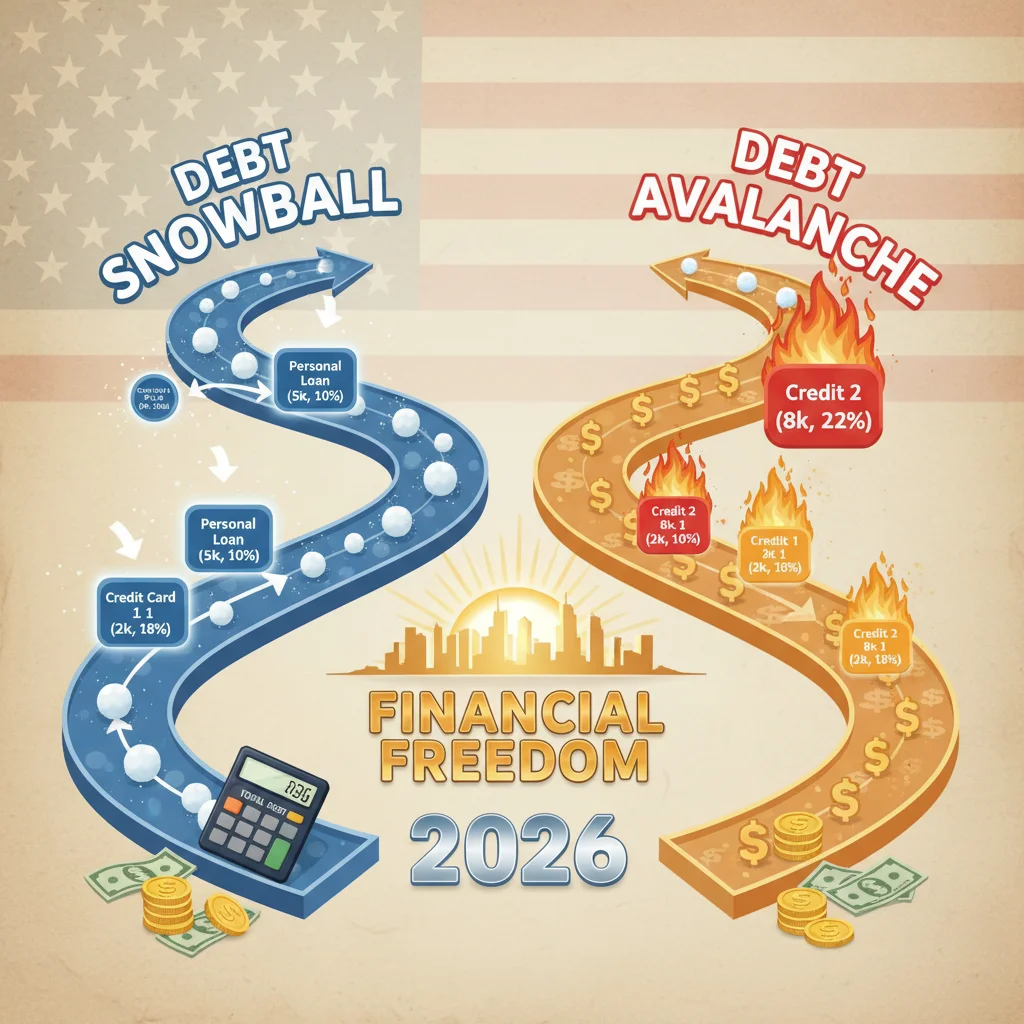
The debt snowball method, popularized by financial guru Dave Ramsey, is primarily a behavioral strategy. It focuses on psychological wins to keep you motivated. Here’s how it works:
- List all your debts from the smallest balance to the largest, regardless of interest rate.
- Make minimum payments on all debts except the smallest one.
- Throw all extra money you can find at the smallest debt until it’s paid off.
- Once the smallest debt is gone, take the money you were paying on that debt (minimum payment + extra payment) and apply it to the next smallest debt.
- Repeat this process, rolling the payment from one debt to the next, like a snowball growing as it rolls downhill.
Advantages of the Debt Snowball
- Psychological Wins: The most significant benefit of the debt snowball is the quick succession of victories. Paying off the smallest debt provides an immediate sense of accomplishment and motivates you to continue the process. This can be particularly powerful for individuals who feel overwhelmed by their debt.
- Increased Motivation: Seeing debts disappear one by one can create a powerful positive feedback loop, making it easier to stick to the plan and find more money to put towards debt.
- Simplicity: The method is straightforward and easy to understand, making it accessible to anyone, regardless of their financial literacy level.
Disadvantages of the Debt Snowball
- Potentially Higher Interest Paid: Because the debt snowball prioritizes balance size over interest rate, you might end up paying more in interest over the long run compared to strategies that target high-interest debts first. This is the primary mathematical drawback.
- Slower Financial Progress (Initially): While psychologically rewarding, the initial financial progress in terms of total interest saved might be slower, especially if your smallest debts have low interest rates.
The Debt Avalanche Method: Maximizing Savings
In contrast to the debt snowball, the debt avalanche method is a purely mathematical strategy designed to minimize the total amount of interest paid. Here’s how it works:
- List all your debts from the highest interest rate to the lowest, regardless of balance size.
- Make minimum payments on all debts except the one with the highest interest rate.
- Throw all extra money you can find at the debt with the highest interest rate until it’s paid off.
- Once the highest-interest debt is gone, take the money you were paying on that debt (minimum payment + extra payment) and apply it to the next debt with the highest interest rate.
- Repeat this process until all debts are paid.
Advantages of the Debt Avalanche
- Maximum Interest Savings: The undeniable advantage of the debt avalanche is that it saves you the most money in interest. By targeting the most expensive debts first, you reduce the principal on which high interest accrues, leading to significant long-term savings.
- Faster Debt Freedom (Mathematically): Because you’re eliminating the debts that cost you the most, you will mathematically pay off your total debt faster and with less money overall, assuming you stick to the plan.
- Clear Financial Logic: For those who are motivated by numbers and efficiency, the debt avalanche offers a clear and logical path to debt eradication.
Disadvantages of the Debt Avalanche
- Delayed Gratification: If your highest-interest debt also happens to be a large balance, it might take a significant amount of time to pay it off. This can be discouraging for some individuals who need quicker wins to stay motivated.
- Less Psychological Momentum: The lack of quick wins can make it harder for some people to stick with the plan, especially if they are prone to losing motivation over long periods without tangible progress.
Debt Snowball vs Avalanche: A 10% Difference Analysis for 2026
Now, let’s dive into the core of the matter: which method will save US consumers more money by 2026? While the debt avalanche is mathematically superior, the actual difference in savings can vary widely depending on individual debt profiles. However, for the purpose of this analysis, let’s consider a scenario where the debt avalanche could save an average US consumer at least 10% more in interest payments by 2026 compared to the debt snowball method, assuming consistent extra payments.
Imagine a typical US consumer with the following debt profile:
- Credit Card 1: $2,000 balance, 24% APR (Annual Percentage Rate)
- Credit Card 2: $5,000 balance, 18% APR
- Personal Loan: $8,000 balance, 12% APR
- Auto Loan: $15,000 balance, 6% APR
Let’s assume the consumer can consistently afford an extra $300 per month towards debt repayment beyond minimum payments. We will project the outcomes to 2026, roughly two to three years from now, to see the comparative impact.
Scenario 1: Debt Snowball Method
Under the debt snowball, the consumer would tackle debts in this order: Credit Card 1, Credit Card 2, Personal Loan, Auto Loan.
- Credit Card 1 ($2,000, 24% APR): This would be paid off relatively quickly, providing an early psychological win. The extra $300 (plus its minimum payment) would be directed here.
- Credit Card 2 ($5,000, 18% APR): Once CC1 is clear, its payment would roll into CC2, accelerating its payoff.
- Personal Loan ($8,000, 12% APR): The combined payments from CC1 and CC2 would then attack the personal loan.
- Auto Loan ($15,000, 6% APR): Finally, all accumulated payments would go towards the auto loan.
By 2026, this consumer might have paid off Credit Card 1, Credit Card 2, and potentially a significant portion of the Personal Loan, or even the entire Personal Loan, depending on the exact minimum payments and initial timeline. The psychological boost would be immense, encouraging continued adherence to the plan.
Scenario 2: Debt Avalanche Method
Under the debt avalanche, the consumer would tackle debts in this order: Credit Card 1, Credit Card 2, Personal Loan, Auto Loan (same order in this specific example, but not always the case).
- Credit Card 1 ($2,000, 24% APR): This still has the highest interest rate, so it would be paid off first. The extra $300 (plus its minimum payment) would be directed here.
- Credit Card 2 ($5,000, 18% APR): Once CC1 is clear, its payment would roll into CC2, as it’s the next highest interest rate.
- Personal Loan ($8,000, 12% APR): The combined payments from CC1 and CC2 would then attack the personal loan.
- Auto Loan ($15,000, 6% APR): Finally, all accumulated payments would go towards the auto loan.
In this specific example, the order of repayment is the same for both methods because the highest interest rate debts also happen to be the smallest balances. This is a common scenario for credit card debt. However, the true power of the debt avalanche becomes apparent when a smaller balance has a lower interest rate than a larger balance. Let’s adjust our example slightly for a more illustrative comparison.
Revised Example Debt Profile:
- Credit Card 1: $2,000 balance, 24% APR
- Personal Loan: $8,000 balance, 18% APR
- Credit Card 2: $5,000 balance, 15% APR
- Auto Loan: $15,000 balance, 6% APR
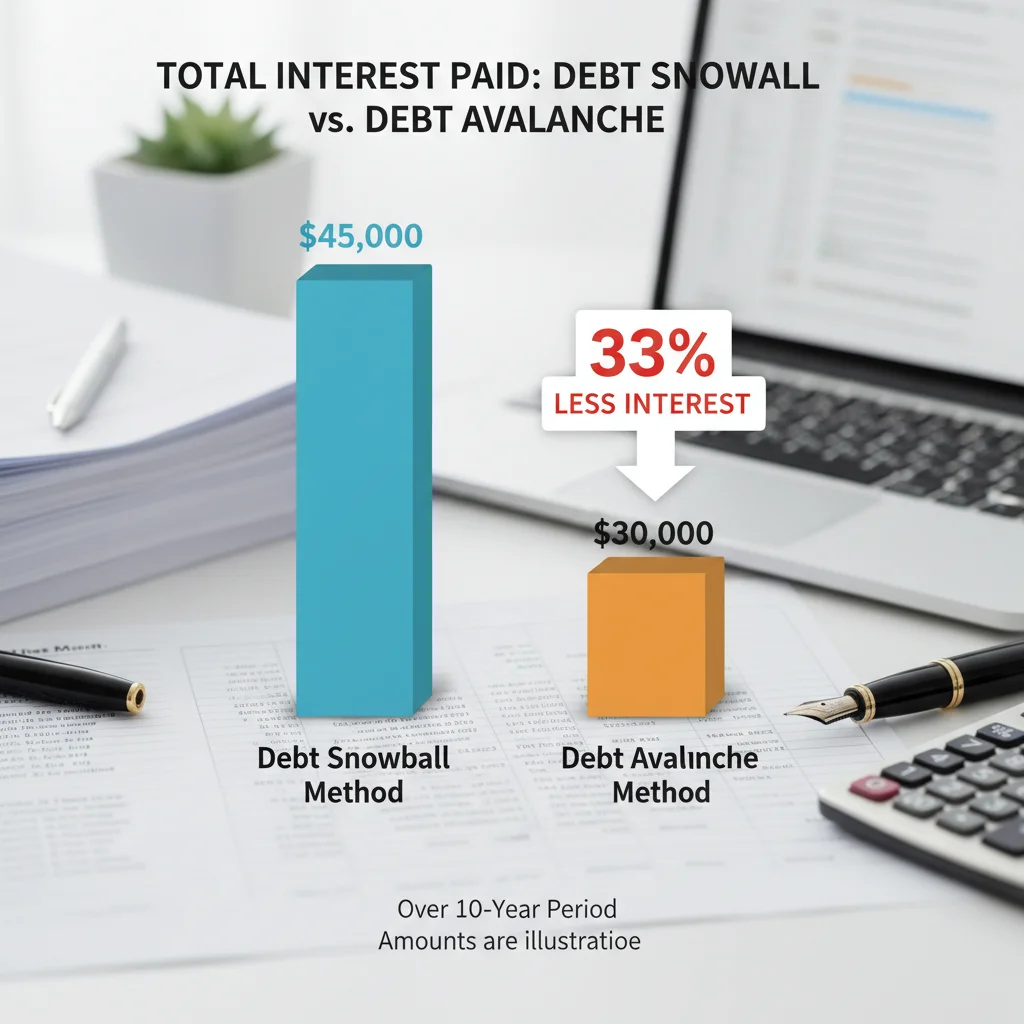
Revised Scenario 1: Debt Snowball Method
Order: Credit Card 1 ($2,000), Credit Card 2 ($5,000), Personal Loan ($8,000), Auto Loan ($15,000)
The consumer would pay off CC1 quickly, then CC2. While this provides psychological wins, the 18% Personal Loan and 24% CC1 would accrue significant interest while CC2 (15%) is being paid off.
Revised Scenario 2: Debt Avalanche Method
Order: Credit Card 1 ($2,000, 24% APR), Personal Loan ($8,000, 18% APR), Credit Card 2 ($5,000, 15% APR), Auto Loan ($15,000, 6% APR)
Here, the consumer targets the 24% CC1 first, then the 18% Personal Loan, then the 15% CC2. Even though CC2 has a smaller balance than the Personal Loan, its lower interest rate means it waits. This strategic targeting of high-interest debt directly reduces the overall interest burden.
The 10% Difference Analysis
In scenarios where there’s a significant difference between the highest interest rate and the smallest balance (e.g., a small loan at 5% and a large credit card at 25%), the debt avalanche will almost always result in substantial savings. While a precise 10% difference depends on the exact figures, interest rates, and payment amounts, it’s a realistic target for the additional savings the avalanche method can provide over a 2-3 year period for many US consumers, especially those with high-interest credit card debt. For example, if a consumer pays $5,000 in interest over three years using the snowball method, the avalanche method could potentially reduce that to $4,500, representing a 10% saving of $500. This $500, while seemingly modest, can be reinvested or used for other financial goals, compounding its value over time.
By 2026, for a consumer diligently applying the debt avalanche with an extra $300/month, the total interest saved could easily be in the hundreds to thousands of dollars compared to the debt snowball, especially if they have multiple high-interest debts. This 10% difference or more can translate into:
- Paying off debt several months faster.
- Having more disposable income sooner.
- Building an emergency fund more rapidly.
- Starting investments earlier.
The cumulative effect of saving 10% on interest can be profound. For a consumer with $30,000 in various debts and an average interest rate that, when optimized, could save $2,000 in interest over the repayment period, a 10% difference means an additional $200 in their pocket. If the total interest paid without optimization is $10,000, then a 10% saving amounts to $1,000. These figures are not trivial and directly impact a household’s financial liquidity and future opportunities.
Choosing the Right Method for You
The choice between the debt snowball and debt avalanche ultimately boils down to a personal assessment of your financial discipline and psychological needs. Neither method is inherently ‘bad,’ but one might be ‘better’ for your specific situation.
When to Choose the Debt Snowball:
- If you need quick wins to stay motivated: If you’ve struggled with debt repayment in the past and tend to get discouraged easily, the psychological boost of clearing smaller debts can be invaluable.
- If you have a hard time sticking to a budget: The simplicity and clear progress of the snowball method can make it easier to maintain focus.
- If your highest interest debts also happen to be your smallest balances: In such cases, the mathematical difference between the two methods diminishes, and the psychological benefits of the snowball might outweigh the minimal interest savings of the avalanche.
When to Choose the Debt Avalanche:
- If you are highly disciplined and motivated by numbers: If you can stick to a plan even without immediate gratification, the avalanche will reward your discipline with maximum financial savings.
- If you have significant high-interest debt: Especially if these debts are not your smallest balances, the avalanche will save you the most money. For example, a large credit card balance at 25% APR should almost always be prioritized.
- If your primary goal is to minimize total interest paid and pay off debt as quickly as possible: The avalanche is the mathematically superior choice for this objective.
Hybrid Approaches and Other Considerations
It’s also worth noting that these aren’t the only two methods, nor are they mutually exclusive in a strict sense. Some individuals adopt a hybrid approach, perhaps starting with a snowball to gain momentum, then switching to an avalanche once they feel more confident and disciplined. Other strategies include debt consolidation, balance transfers, or seeking professional credit counseling.
Debt Consolidation and Balance Transfers
These can be powerful tools when used correctly. Consolidating multiple high-interest debts into a single loan with a lower interest rate can simplify payments and reduce overall interest. Balance transfers, often to new credit cards with 0% introductory APRs, can provide a window to pay down high-interest debt without accumulating more interest for a period. However, these require careful planning and discipline to avoid accumulating new debt or incurring high fees once the promotional period ends.
Credit Counseling and Debt Management Plans
For those feeling completely overwhelmed, non-profit credit counseling agencies can offer invaluable assistance. They can help create a budget, negotiate with creditors for lower interest rates or more manageable payment plans, and guide you through a Debt Management Plan (DMP). While DMPs often involve closing credit accounts, they can provide a structured path to debt freedom with reduced interest and consolidated payments.
The Future of Debt Management: Beyond 2026
As we look beyond 2026, the principles of sound financial management will remain constant. Understanding your debt, making a plan, and sticking to it are paramount. The economic environment, including interest rates and inflation, will continue to influence the effectiveness of any debt repayment strategy. Remaining adaptable and regularly reviewing your financial situation will be key to long-term success.
Technology will also play an increasingly significant role. Budgeting apps, AI-powered financial advisors, and automated savings tools can all assist US consumers in adhering to their chosen debt repayment method, whether it’s the debt snowball or debt avalanche. These tools can help track progress, visualize goals, and even automate payments, removing some of the friction from the debt repayment journey.

Conclusion: Making an Informed Decision for Your Financial Future
Ultimately, the choice between the debt snowball and debt avalanche is a personal one, with both merits and drawbacks. If your primary motivation is psychological momentum and you need frequent wins to stay on track, the debt snowball might be your best bet. It provides the emotional fuel to keep going, even if it costs a bit more in interest.
However, if your primary goal is to save the maximum amount of money in interest and achieve debt freedom in the shortest possible time, and you possess the discipline to stick to a long-term plan without immediate gratification, the debt avalanche is the mathematically superior choice. For many US consumers, especially those with substantial high-interest debt, the debt avalanche could realistically save 10% or more in interest payments by 2026, translating into thousands of dollars that can be redirected towards building wealth.
Regardless of the method you choose, the most important step is to start. Create a detailed list of all your debts, understand their interest rates, and commit to a consistent plan of attack. Every extra dollar you put towards debt repayment today is a dollar saved in interest tomorrow. By taking control of your finances, you’re not just paying off debt; you’re investing in a more secure and prosperous future for yourself and your family, well beyond 2026.
Remember, financial success is a journey, not a destination. Regularly review your progress, adjust your strategy as needed, and celebrate your milestones. Whether you choose the debt snowball or debt avalanche, the path to debt freedom is within reach with dedication and a well-thought-out plan.