The 2026 Guide to Student Loan Debt Forgiveness Programs: Are You Eligible for Relief?
Student loan debt continues to be a significant burden for millions of Americans, impacting financial stability, career choices, and major life decisions. As we look towards 2026, understanding the evolving landscape of student loan forgiveness 2026 programs is crucial for anyone seeking relief. The policies and programs surrounding student debt are dynamic, with ongoing discussions and potential reforms shaping the future of repayment and forgiveness. This comprehensive guide aims to demystify these programs, providing you with the most up-to-date information on eligibility, application processes, and what to expect in the coming years.
Navigating the complexities of federal and state-sponsored initiatives can be daunting. From Public Service Loan Forgiveness (PSLF) to income-driven repayment (IDR) plans and specific profession-based programs, the options can seem endless. Our goal is to break down these opportunities, helping you determine if you qualify for student loan forgiveness 2026 and how to take the necessary steps to reduce your financial burden. Whether you’re a recent graduate, a long-time borrower, or considering future education, this guide will serve as an invaluable resource.
Understanding the Current Landscape of Student Loan Forgiveness
Before diving into the specifics of student loan forgiveness 2026, it’s essential to grasp the current state of federal student aid and debt relief. The past few years have seen significant changes, including payment pauses, interest waivers, and targeted forgiveness initiatives. These actions have highlighted the government’s commitment to addressing the student debt crisis, but they also underscore the need for borrowers to stay informed.
Federal student loans offer various repayment plans and forgiveness options that are generally more robust than those available for private loans. Understanding the distinction between these loan types is the first step. Federal loans are issued by the U.S. Department of Education, while private loans come from banks, credit unions, and other financial institutions. Most forgiveness programs apply exclusively to federal student loans, making it vital to confirm your loan type.
The primary mechanisms for federal loan forgiveness typically fall into a few broad categories: public service, income-driven repayment, and specific circumstances (e.g., school closure, disability). Each category has distinct eligibility requirements and application procedures. As we approach 2026, while the core structures of these programs are likely to remain, there could be modifications or new initiatives introduced based on legislative changes or executive actions. Staying vigilant and regularly checking official sources will be key to leveraging any new opportunities for student loan forgiveness 2026.
Public Service Loan Forgiveness (PSLF): A Cornerstone for Public Servants
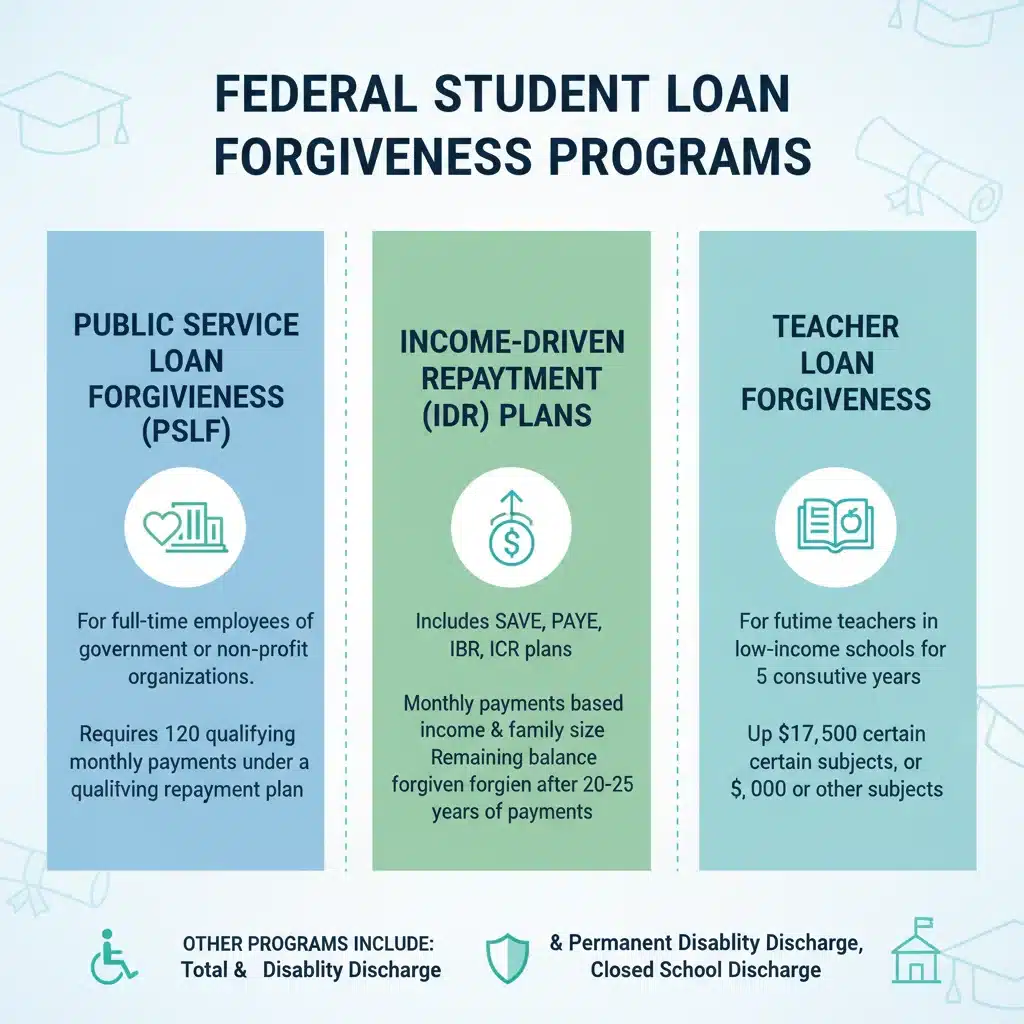
The Public Service Loan Forgiveness (PSLF) program is one of the most well-known avenues for federal student loan relief, designed to encourage individuals to work in public service. If you’re employed by a U.S. federal, state, local, or tribal government organization or a qualifying non-profit organization, you might be eligible for PSLF. The program forgives the remaining balance on your Direct Loans after you’ve made 120 qualifying monthly payments while working full-time for a qualifying employer.
For student loan forgiveness 2026, the fundamental requirements for PSLF are expected to remain consistent:
- Eligible Loans: Only Direct Loans qualify. If you have Federal Family Education Loan (FFEL) Program loans or Federal Perkins Loans, you’ll need to consolidate them into a Direct Consolidation Loan to be eligible.
- Eligible Employment: You must work full-time for a qualifying employer. This includes government organizations at any level, 501(c)(3) non-profit organizations, and other non-profits that provide specific public services.
- Qualifying Payments: You must make 120 qualifying monthly payments. These payments must be made under a qualifying income-driven repayment (IDR) plan, be on time, for the full amount due, and while employed full-time by a qualifying employer.
The PSLF program has undergone significant reforms in recent years, including the Limited PSLF Waiver and the IDR Account Adjustment, which have retroactively counted more payments towards forgiveness for many borrowers. While these specific waivers may not extend directly into 2026, their impact on borrower accounts will continue to be felt, and future adjustments are always a possibility. It’s crucial for public servants to regularly submit the PSLF Employment Certification Form (ECF) to track their progress and ensure their employment and payments are being counted correctly. This proactive approach will help you stay on track for student loan forgiveness 2026.
Income-Driven Repayment (IDR) Plans and Forgiveness
Income-Driven Repayment (IDR) plans are another critical pathway to student loan forgiveness 2026, offering a safety net for borrowers whose incomes are low relative to their student loan debt. These plans adjust your monthly payment amount based on your income and family size, typically capping payments at an affordable percentage of your discretionary income. After a specified number of years (20 or 25, depending on the plan and whether you have graduate loans), any remaining balance on your federal student loans is forgiven.
There are several types of IDR plans, including:
- Revised Pay As You Earn (REPAYE) / SAVE Plan: This plan, recently updated and rebranded as the SAVE Plan, often offers the lowest monthly payments. For undergraduate loans, remaining balances are forgiven after 20 years; for graduate loans, it’s 25 years. The SAVE plan also offers an interest subsidy, preventing your balance from growing due to unpaid interest if your payment doesn’t cover it.
- Pay As You Earn (PAYE) Plan: Forgiveness after 20 years of payments.
- Income-Based Repayment (IBR) Plan: Forgiveness after 20 or 25 years, depending on when you took out your loans.
- Income-Contingent Repayment (ICR) Plan: Forgiveness after 25 years.
A significant development impacting IDR plans is the IDR Account Adjustment. This one-time adjustment is reviewing past payments for all Direct Loan and FFEL Program loan borrowers, potentially crediting more months toward IDR forgiveness than previously counted. This adjustment is expected to bring many borrowers closer to forgiveness, with some even reaching immediate forgiveness. While the adjustment itself is a one-time event, its effects will carry forward into 2026 and beyond, making it a crucial factor in understanding your path to student loan forgiveness 2026.
It is vital to enroll in an IDR plan if you are struggling with payments or aiming for forgiveness through this route. You must recertify your income and family size annually to remain on an IDR plan and ensure your payments are calculated correctly. Missing recertification can lead to capitalized interest and higher monthly payments, delaying your path to student loan forgiveness 2026.
Teacher Loan Forgiveness and Other Profession-Based Programs
Beyond PSLF, specific professions, particularly in education and healthcare, have dedicated loan forgiveness programs. These programs aim to attract and retain talent in high-need areas.
Teacher Loan Forgiveness (TLF): If you teach full-time for five complete and consecutive academic years in a low-income elementary school, secondary school, or educational service agency, you may be eligible for forgiveness of up to $17,500 on your Direct Subsidized and Unsubsidized Loans and your Subsidized and Unsubsidized Federal Stafford Loans. The amount of forgiveness depends on the subject you teach (e.g., highly qualified math, science, or special education teachers may qualify for the higher amount).
For student loan forgiveness 2026, teachers should ensure they meet the specific requirements, including:
- Teaching in a school or agency listed in the U.S. Department of Education’s Annual Directory of Designated Low-Income Schools for Teacher Cancellation Benefits.
- Being a highly qualified teacher as defined by federal regulations.
Perkins Loan Cancellation for Teachers: If you have Federal Perkins Loans, you may be eligible for cancellation of up to 100% of your loan for teaching in a low-income school or teaching specific subjects. This program is distinct from TLF and has its own set of rules. While new Perkins Loans are no longer being disbursed, existing loans may still qualify for this benefit.
Other Profession-Based Programs:
- Nurse Corps Loan Repayment Program: For registered nurses and nurse faculty working in critical shortage facilities or eligible nursing schools.
- National Health Service Corps (NHSC) Loan Repayment Program: For healthcare professionals (physicians, dentists, nurses, mental health providers) working in underserved communities.
- State-Specific Programs: Many states offer their own loan repayment assistance programs (LRAPs) for professionals in various fields, often tied to serving in specific geographic areas or underserved populations. These can be particularly relevant for student loan forgiveness 2026, as state programs can change and expand.
It’s crucial to research both federal and state-specific programs relevant to your profession. Eligibility criteria can be highly detailed, and missing a single requirement could jeopardize your chances for student loan forgiveness 2026.
Forgiveness for Specific Circumstances: Disability, School Closure, and Borrower Defense
Beyond service or income, certain life events or unfortunate circumstances can lead to federal student loan forgiveness. These are critical avenues for student loan forgiveness 2026 for those facing severe hardship.
Total and Permanent Disability (TPD) Discharge: If you are unable to engage in any substantial gainful activity due to a physical or mental impairment that can be expected to result in death, has lasted for a continuous period of not less than 60 months, or can be expected to last for a continuous period of not less than 60 months, you may qualify for a TPD discharge. This can be evidenced by a Social Security Administration (SSA) notice of award for Social Security Disability Insurance (SSDI) or Supplemental Security Income (SSI) benefits, a certification from a physician, or a Veterans Affairs (VA) determination of unemployability due to a service-connected disability.
Closed School Discharge: If your school closed while you were enrolled or shortly after you withdrew, and you couldn’t complete your program because of the closure, you might be eligible for a closed school discharge. This typically applies if you didn’t transfer your credits to another school or complete a comparable program elsewhere. The rules for closed school discharge can be complex, especially regarding the timeframe of withdrawal and closure, so it’s important to consult the Department of Education’s guidelines for student loan forgiveness 2026.
Borrower Defense to Repayment: This provision allows borrowers to seek forgiveness if their school misled them or engaged in other misconduct in violation of certain state laws. Common grounds for borrower defense claims include misrepresentation of job placement rates, program accreditation, or the quality of instruction. The process for borrower defense can be lengthy and requires substantial documentation to prove the school’s misconduct. Keep an eye on any new announcements or streamlined processes that might emerge for student loan forgiveness 2026, as this area has seen significant regulatory changes.
Death Discharge: While not applicable to the borrower, federal student loans are discharged if the borrower dies. A family member or representative must provide proof of death to the loan servicer.
The Impact of Potential Legislative Changes on 2026 Forgiveness
The landscape of student loan forgiveness 2026 is not static; it is heavily influenced by political discourse and potential legislative action. While specific large-scale, across-the-board forgiveness initiatives have faced challenges, the conversation around student debt relief remains prominent. Future legislation could introduce new programs, expand existing ones, or alter eligibility criteria.
For instance, discussions around simplifying IDR plans, expanding PSLF eligibility, or even implementing new forms of targeted forgiveness based on economic hardship or specific societal contributions are ongoing. Borrowers should pay close attention to news from the U.S. Department of Education, Congressional actions, and presidential executive orders. Official government websites are always the most reliable sources of information regarding changes to federal student aid programs.
Any significant changes to student loan forgiveness 2026 will likely be announced with ample time for borrowers to understand and prepare. However, it’s prudent to plan based on current programs while remaining adaptable to potential future developments. Don’t delay applying for programs you currently qualify for, hoping for a better option in the future, as current eligibility is concrete.
Avoiding Scams and Finding Reliable Information
Unfortunately, the complexity and high stakes of student loan forgiveness make borrowers vulnerable to scams. Companies often promise quick or guaranteed forgiveness for a fee, but these are almost always fraudulent. The U.S. Department of Education and its authorized loan servicers do not charge fees for applying for federal loan forgiveness programs. Any communication asking for payment to process your forgiveness application should be viewed with extreme skepticism.
To protect yourself and ensure you receive accurate information about student loan forgiveness 2026:
- Go to Official Sources: The official website of the U.S. Department of Education (StudentAid.gov) is the authoritative source for all federal student loan information, including forgiveness programs.
- Contact Your Loan Servicer: Your loan servicer (e.g., MOHELA, Nelnet, Aidvantage) can provide specific details about your loans and assist with applications for IDR plans or PSLF.
- Be Wary of Unsolicited Offers: Legitimate government agencies will not call, email, or text you out of the blue demanding immediate action or payment for forgiveness.
- Never Pay for Free Services: All federal loan forgiveness applications are free.
Staying informed and cautious is your best defense against predatory practices while seeking legitimate student loan forgiveness 2026.
Steps to Prepare for Student Loan Forgiveness in 2026
Even if 2026 seems far off, there are proactive steps you can take now to position yourself for potential student loan forgiveness 2026. Preparation is key to navigating the application processes and ensuring you meet all requirements.
- Identify Your Loan Types: Determine if your loans are federal or private. As mentioned, most forgiveness programs apply only to federal loans. If you have FFEL or Perkins Loans, consider consolidation into a Direct Consolidation Loan if it benefits your forgiveness goals (e.g., for PSLF or IDR).
- Understand Your Repayment History: Access your loan history on StudentAid.gov to review past payments, repayment plans, and loan statuses. This is crucial for tracking progress towards IDR or PSLF forgiveness.
- Research Eligibility for Programs: Based on your employment, income, and circumstances, research which forgiveness programs you might qualify for. Use the PSLF Help Tool on StudentAid.gov if you are in public service.
- Enroll in an Income-Driven Repayment Plan: If you’re pursuing IDR or PSLF, ensure you are on a qualifying IDR plan and recertify your income and family size annually.
- Maintain Accurate Records: Keep thorough records of your employment history, payment confirmations, and any correspondence with your loan servicer or the Department of Education. This documentation can be invaluable if there are discrepancies or issues with your application.
- Stay Informed: Regularly check StudentAid.gov and reputable news sources for updates on federal student loan policies and new initiatives related to student loan forgiveness 2026.
- Consider Professional Advice (Cautiously): While most services are free through your servicer or the Department of Education, if your situation is particularly complex, you might consider consulting a non-profit credit counselor or a financial advisor specializing in student loans. Always verify their credentials and ensure they are not charging for services available for free elsewhere.

The Future of Student Loan Debt and Forgiveness
The conversation around student loan debt and forgiveness is far from over. As we head into 2026, it’s clear that policymakers will continue to grapple with how to best support borrowers while addressing the rising cost of higher education. While broad-based forgiveness remains a topic of debate, targeted programs and adjustments to existing ones are more likely to evolve.
The recent efforts to rectify past administrative errors within IDR plans and PSLF demonstrate a commitment to ensuring that borrowers who have met their obligations receive the forgiveness they are due. These adjustments have already provided significant relief to many and set a precedent for future improvements in the administration of federal student aid programs. For borrowers, this means a greater likelihood of their payments being accurately counted towards forgiveness goals, making the pursuit of student loan forgiveness 2026 more transparent and achievable.
Furthermore, discussions about the student loan system often include proposals for preventative measures, such as making college more affordable or simplifying the federal aid application process. While these long-term reforms may not directly impact existing loan forgiveness programs by 2026, they signal a broader effort to create a more sustainable and equitable higher education financing system. For current borrowers, the immediate focus should remain on understanding and utilizing the existing and anticipated programs for student loan forgiveness 2026.
It’s also worth noting the potential for state-level initiatives to grow. Many states recognize the economic impact of student debt on their residents and are exploring or implementing their own loan repayment assistance programs. These can complement federal programs, offering additional layers of support for specific professions or residents in certain areas. Keeping an eye on local government announcements can uncover additional avenues for relief.
Ultimately, navigating student loan forgiveness requires diligence, patience, and a commitment to staying informed. The path to debt relief may not always be straightforward, but by understanding the available programs, carefully tracking your progress, and avoiding common pitfalls, you can significantly improve your chances of achieving student loan forgiveness 2026 and securing a more stable financial future.
Conclusion: Your Path to Student Loan Forgiveness in 2026
The prospect of student loan forgiveness 2026 offers a beacon of hope for many borrowers burdened by educational debt. While the landscape is constantly shifting, a solid understanding of current federal programs like PSLF, income-driven repayment plans (especially the SAVE Plan), and profession-specific forgiveness options is your strongest asset. Additionally, knowing about discharge options for disability, school closure, and borrower defense can provide crucial relief under specific circumstances.
To maximize your chances of obtaining student loan forgiveness 2026, it is imperative to:
- Confirm your loan types and consolidate if necessary.
- Actively manage your repayment plan, ensuring you’re on an eligible IDR plan if pursuing forgiveness through that route.
- Regularly submit employment certification for PSLF.
- Keep meticulous records of all payments and communications.
- Stay vigilant against scams and rely only on official government sources for information.
- Be prepared for potential legislative changes and adjust your strategy accordingly.
Student loan debt relief is a journey, not a destination. By taking proactive steps today and remaining informed, you can effectively navigate the available programs and work towards a future free from the burden of student loans. Your financial well-being is within reach, and understanding the opportunities for student loan forgiveness 2026 is a critical step on that journey. Don’t hesitate to reach out to your loan servicer or visit StudentAid.gov for personalized guidance and to begin or continue your path toward forgiveness.