Student Loan Debt Forgiveness 2026: Eligibility & Future Changes

Student loan debt has become a significant financial burden for millions of Americans, impacting everything from homeownership to retirement planning. The landscape of student loan debt forgiveness is constantly evolving, with new policies, programs, and legislative discussions shaping the future for borrowers. As we approach 2026, many are wondering what the future holds for student loan forgiveness. This comprehensive guide delves into the current state of student loan relief, projected changes, eligibility criteria, and strategies to help you navigate the complex world of student loan debt forgiveness 2026.
Understanding the Current Student Loan Forgiveness Landscape
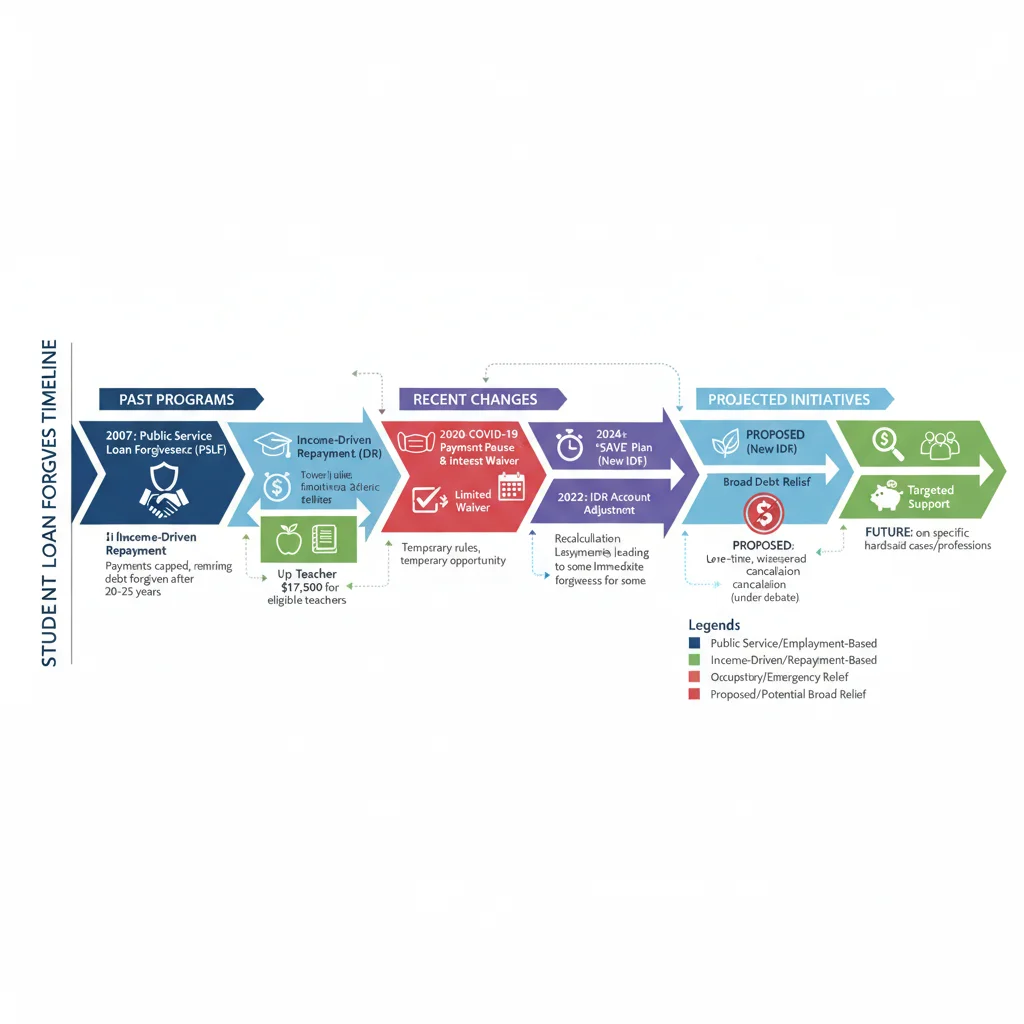
Before looking ahead to 2026, it’s crucial to understand the existing mechanisms for student loan forgiveness. The federal government offers several programs designed to provide relief to borrowers under specific circumstances. These programs have been subject to significant changes and expansions in recent years, particularly in response to economic challenges and policy shifts.
Public Service Loan Forgiveness (PSLF)
The Public Service Loan Forgiveness (PSLF) program is arguably one of the most well-known and impactful forgiveness initiatives. It aims to encourage individuals to enter and remain in public service careers by forgiving the remaining balance on their Direct Loans after they have made 120 qualifying monthly payments while working full-time for a qualifying employer. Qualifying employers include government organizations (federal, state, local, or tribal), non-profit organizations that are tax-exempt under Section 501(c)(3) of the Internal Revenue Code, and certain other non-profit organizations that provide specific public services.
Recent changes to PSLF, such as the limited PSLF waiver and the PSLF & TEPSLF (Temporary Expanded Public Service Loan Forgiveness) program, have made it easier for more borrowers to qualify by broadening the types of payments and repayment plans that count towards the 120 payments. While these waivers have largely concluded, their impact has set a precedent for potential future adjustments to the program.
Income-Driven Repayment (IDR) Plan Forgiveness
Income-Driven Repayment (IDR) plans are designed to make student loan payments more manageable by capping them at a percentage of your discretionary income. There are several IDR plans, including Income-Based Repayment (IBR), Pay As You Earn (PAYE), Revised Pay As You Earn (REPAYE), and Income-Contingent Repayment (ICR). A key feature of IDR plans is that any remaining loan balance is forgiven after 20 or 25 years of qualifying payments, depending on the plan and whether you have loans for graduate or undergraduate study.
The Biden administration has made significant efforts to improve IDR plans, including a one-time account adjustment that counts more past payments towards forgiveness, including periods of deferment and forbearance that previously didn’t qualify. This adjustment has already resulted in forgiveness for hundreds of thousands of borrowers and is expected to continue impacting millions more. The new Saving on a Valuable Education (SAVE) Plan, which replaced the REPAYE Plan, offers even more generous terms, including lower monthly payments and an interest subsidy, making IDR forgiveness more accessible for many.
Teacher Loan Forgiveness
Teachers who work full-time for five consecutive complete academic years in certain low-income schools or educational service agencies may be eligible for forgiveness of up to $17,500 on their Direct Subsidized and Unsubsidized Loans, and their Subsidized and Unsubsidized Federal Stafford Loans. This program has specific criteria regarding the type of school, the subject taught, and the loan types.
Perkins Loan Cancellation
Federal Perkins Loans, while no longer disbursed, offered cancellation options for borrowers who entered certain public service professions. The amount of the loan that could be canceled depended on the type of service performed and the length of service.
Total and Permanent Disability (TPD) Discharge
Borrowers who are totally and permanently disabled may be eligible to have their federal student loans discharged. This discharge can be granted based on documentation from a physician, a determination from the Department of Veterans Affairs (VA), or a Social Security Administration (SSA) notice of award for Social Security Disability Insurance (SSDI) or Supplemental Security Income (SSI) benefits.
Borrower Defense to Repayment
This program provides relief to borrowers whose schools engaged in misconduct, such as making false promises about job prospects or misleading students about tuition costs. If a borrower can prove they were defrauded by their school, their federal student loans may be discharged.
Closed School Discharge
If your school closed while you were enrolled or shortly after you withdrew, and you didn’t complete your program at another school, you might be eligible for a closed school discharge, which forgives your federal student loans.
Potential Changes and the Outlook for Student Loan Forgiveness 2026
The political and economic climate significantly influences the future of student loan forgiveness. While specific legislation for 2026 is still uncertain, several factors and ongoing discussions provide clues about what borrowers might expect.
Administrative Actions and Regulatory Changes
The Biden administration has demonstrated a commitment to providing student loan relief through executive actions and regulatory changes, rather than relying solely on congressional legislation. The one-time IDR account adjustment and the creation of the SAVE Plan are prime examples. It’s plausible that similar administrative initiatives could continue to be explored, especially if legislative efforts remain stalled.
The Department of Education is continually reviewing and refining its policies. This could lead to further adjustments to existing programs like PSLF and IDR, potentially expanding eligibility or simplifying application processes. For instance, there might be ongoing efforts to address issues such as administrative forbearance leading to lost progress towards forgiveness or difficulties in transferring credits for borrowers affected by school closures.
Legislative Debates and Congressional Action
Congressional action on broad student loan forgiveness has been challenging, with significant partisan divides. While some lawmakers advocate for widespread debt cancellation, others oppose it due to concerns about cost and fairness. The likelihood of a large-scale, across-the-board forgiveness program being passed by Congress by 2026 remains uncertain and highly dependent on the political landscape, including the outcomes of upcoming elections.
However, targeted legislative efforts could gain traction. This might include expanding forgiveness for specific professions (e.g., healthcare workers, teachers in high-need areas), increasing the benefits of existing programs, or providing relief for borrowers in particularly vulnerable situations. Any legislative changes would likely go through a lengthy process of debate and negotiation.
Economic Factors and Inflation
Economic conditions, including inflation and interest rates, could also influence student loan policy. High inflation might increase calls for relief, while concerns about government spending could temper such efforts. Policymakers will likely weigh the economic impact of student loan debt on individual households and the broader economy when considering future forgiveness initiatives.
The Role of the Supreme Court
Past attempts at broad student loan forgiveness through executive action have faced legal challenges, with the Supreme Court ultimately striking down some proposals. This legal precedent means that any future large-scale forgiveness efforts would need to be carefully crafted to withstand legal scrutiny, potentially limiting the scope of what can be achieved through executive power alone.
Eligibility for Student Loan Forgiveness 2026: What to Expect
While the exact criteria for student loan forgiveness in 2026 cannot be predicted with certainty, current trends and discussions suggest several key areas of focus for eligibility.
Federal Loans vs. Private Loans
It’s critical to understand that almost all existing and proposed federal student loan forgiveness programs apply exclusively to federal student loans. Private student loans, issued by banks or other private lenders, typically do not qualify for federal forgiveness programs. Borrowers with private loans have very limited options for relief, usually restricted to refinancing or negotiating with their lender during periods of financial hardship.
Income and Financial Hardship
Income-driven repayment plans and the new SAVE Plan are clear indicators that a borrower’s income and financial hardship will continue to be significant factors in determining eligibility for forgiveness. These plans are designed to provide the most relief to low-income borrowers, and it’s reasonable to expect that future programs might also incorporate income thresholds or financial need assessments.
Loan Type and Repayment History
The type of federal loan (e.g., Direct Loans, FFEL Program loans, Perkins Loans) and a borrower’s repayment history (e.g., consistent payments, periods of deferment or forbearance) are consistently central to eligibility. Programs like PSLF and IDR forgiveness require a certain number of qualifying payments. Borrowers should ensure their loans are consolidated into Direct Loans if necessary to maximize their chances of qualifying for these programs.
Specific Professions and Public Service
The emphasis on public service and certain professions (teachers, healthcare workers, military personnel) is likely to continue. Programs like PSLF and Teacher Loan Forgiveness highlight the government’s interest in incentivizing careers that benefit society. It’s possible that the list of qualifying professions could expand or that the benefits for existing ones could increase.
Borrower Circumstances (Disability, Fraud, School Closure)
Discharge options for borrowers with total and permanent disabilities, those who were defrauded by their schools, or those whose schools closed are fundamental aspects of student loan relief. These protections are generally expected to remain in place and may even be streamlined or expanded to better serve vulnerable borrowers.
Strategies to Prepare for Student Loan Forgiveness 2026
Even with uncertainty surrounding future policies, there are proactive steps you can take now to position yourself for potential student loan forgiveness in 2026 and beyond.
1. Consolidate Your Federal Loans
If you have older federal loans, such as FFEL Program loans or Perkins Loans, consolidating them into a Direct Consolidation Loan is often a crucial step. Direct Loans are the only type of federal loan eligible for PSLF and are generally the most flexible for IDR plans. Consolidation can also simplify your repayment by combining multiple loans into one with a single servicer and payment.
2. Enroll in an Income-Driven Repayment (IDR) Plan
Enrollment in an IDR plan, particularly the new SAVE Plan, is highly recommended for most federal student loan borrowers. Not only does it make your monthly payments affordable based on your income, but it also puts you on the path to forgiveness after 20 or 25 years of payments. The SAVE Plan offers significant benefits, including preventing interest capitalization under certain conditions and potentially lowering monthly payments to as low as $0 for some borrowers. Moreover, the ongoing IDR account adjustment will count more past periods towards forgiveness, making current enrollment even more valuable.
3. Track Your Payments for PSLF
If you work in public service, ensure you are on track for PSLF. Submit an Employment Certification Form (ECF) annually or whenever you change employers. This allows the Department of Education to track your qualifying employment and payments. Regularly check your progress through your loan servicer’s online portal to ensure all your payments are being counted correctly.
4. Stay Informed and Monitor Policy Changes
The landscape of student loan forgiveness is dynamic. Regularly check official sources like the Federal Student Aid (FSA) website (studentaid.gov) for the latest updates on programs, eligibility, and application deadlines. Follow reputable financial news outlets and government announcements. Subscribing to email updates from FSA can also be beneficial.
5. Update Your Contact Information
Ensure your loan servicer and the Department of Education have your most current contact information (mailing address, email, phone number). This ensures you receive important notifications about your loans, repayment options, and any new forgiveness programs.
6. Keep Detailed Records
Maintain thorough records of all your loan documents, payment histories, correspondence with your loan servicer, and any employment verification forms. This documentation can be invaluable if you need to dispute an error or prove your eligibility for a forgiveness program.
7. Beware of Scams
Unfortunately, the complexity of student loan forgiveness has led to an increase in scams. Be highly skeptical of any company or individual that promises guaranteed forgiveness for a fee, asks for your FSA ID, or pressures you to act immediately. Legitimate help and information are always available for free from your loan servicer or the Department of Education.
8. Understand the Tax Implications
While most federal student loan forgiveness is currently tax-free through 2025 due to the American Rescue Plan Act, this provision is set to expire. If broad forgiveness or IDR forgiveness occurs in 2026 or later, the forgiven amount could potentially be considered taxable income by the IRS. It’s essential to consult with a tax professional to understand the potential tax implications of any future forgiveness you receive.
The Future of Student Loan Debt Forgiveness: What Lies Ahead?
Looking beyond 2026, the discussion around student loan debt is likely to continue to be a prominent feature of national policy debates. The sheer volume of outstanding student debt and its impact on economic mobility ensure that it will remain a critical issue for policymakers, economists, and borrowers alike.
Broader Reforms to Higher Education Funding
Some advocates argue that true long-term solutions require more than just forgiveness; they demand fundamental reforms to how higher education is funded and how student loans are issued. This could involve proposals for tuition-free college, increased Pell Grant funding, or stricter regulations on predatory lending practices by institutions. While these are larger systemic changes, they could indirectly reduce the need for future forgiveness programs.
Targeted vs. Universal Forgiveness
The debate between targeted forgiveness (e.g., for specific professions, low-income borrowers) and universal forgiveness (e.g., across-the-board cancellation for all borrowers) is likely to persist. Future policies may continue to lean towards targeted approaches due to political feasibility and concerns about equitable distribution of benefits.
Impact of Technology and Data
Advances in data collection and analysis could lead to more efficient and personalized approaches to student loan management and forgiveness. This might include automated enrollment in IDR plans, streamlined application processes for forgiveness, or more accurate tracking of borrower eligibility.
The Role of States
Beyond federal programs, some states offer their own student loan assistance or forgiveness programs, often targeting specific professions or residents who commit to working in underserved areas within the state. It’s worth researching what programs might be available at the state level in addition to federal options.

Frequently Asked Questions about Student Loan Forgiveness 2026
Will there be widespread student loan forgiveness in 2026?
The likelihood of widespread, across-the-board student loan forgiveness by 2026 is uncertain and highly dependent on political developments and legislative action. While the Biden administration has pursued targeted relief through executive actions (like IDR adjustments and the SAVE Plan), broad forgiveness has faced legal challenges and congressional hurdles. Borrowers should not rely solely on the promise of universal forgiveness but focus on existing programs.
What is the SAVE Plan, and how does it relate to forgiveness?
The Saving on a Valuable Education (SAVE) Plan is a new Income-Driven Repayment (IDR) plan that replaced the REPAYE Plan. It offers lower monthly payments for many borrowers, especially those with lower incomes, and prevents interest from growing on your loan balance if you make your scheduled payments. Under the SAVE Plan, remaining loan balances are forgiven after 20 or 25 years of qualifying payments, depending on your education level. It is currently one of the most generous paths to forgiveness.
Are private student loans eligible for federal forgiveness programs?
No, almost all federal student loan forgiveness programs, including PSLF, IDR forgiveness, and disability discharge, apply exclusively to federal student loans. Private student loans are issued by banks and private lenders and typically do not qualify for these federal relief options. Options for private loans are generally limited to refinancing or negotiating with the lender.
How can I increase my chances of qualifying for student loan forgiveness?
To increase your chances, ensure all your federal loans are Direct Loans (consolidate if necessary), enroll in an appropriate Income-Driven Repayment (IDR) plan like SAVE, and if applicable, pursue Public Service Loan Forgiveness (PSLF) by working for a qualifying employer and submitting annual Employment Certification Forms. Stay informed about policy changes and maintain accurate records.
What should I do to prepare for potential changes in 2026?
Proactively manage your loans by understanding current programs, consolidating federal loans if needed, enrolling in an IDR plan, and tracking your payments. Stay updated through official sources like studentaid.gov. Ensure your contact information is current with your loan servicer and be wary of scams promising guaranteed forgiveness.
Will forgiven student loan debt be taxable in 2026?
Under the American Rescue Plan Act, federal student loan forgiveness is tax-free through December 31, 2025. If forgiveness occurs in 2026 or later, the forgiven amount could potentially be considered taxable income by the IRS unless new legislation extends the tax-free provision. It’s crucial to consult with a tax professional regarding your specific situation.
What if I’m struggling to make my student loan payments now?
If you’re struggling, immediately contact your loan servicer. They can help you explore options like enrolling in an Income-Driven Repayment (IDR) plan, which can significantly lower your monthly payments, or applying for deferment or forbearance, which allows you to temporarily postpone payments. These options can help prevent default and keep you on track for potential future forgiveness.
Conclusion
The path to student loan debt forgiveness in 2026 is paved with both existing opportunities and potential future changes. While broad, universal forgiveness remains a subject of ongoing debate and legislative challenges, current programs like Public Service Loan Forgiveness (PSLF) and Income-Driven Repayment (IDR) plans, especially the new SAVE Plan, offer tangible pathways to relief for millions of borrowers. By understanding these programs, proactively managing your federal loans, and staying informed about policy developments, you can position yourself to take advantage of any available student loan forgiveness 2026 and beyond. The key is to be engaged, informed, and strategic in your approach to student loan repayment, focusing on the options that are currently available while keeping an eye on the evolving landscape of federal student aid.