2026 Federal Debt Relief Programs: Comprehensive Guide

Navigating 2026 Debt Relief Programs: What You Need to Know About New Federal Initiatives
As we approach 2026, many individuals and families across the United States are looking for solutions to their financial burdens. Debt can be a significant source of stress, impacting everything from daily living to long-term financial stability. Fortunately, the federal government often introduces or modifies programs designed to provide relief. Understanding these 2026 Debt Relief Programs is crucial for anyone seeking to improve their financial outlook. This comprehensive guide will delve into the anticipated federal initiatives, eligibility criteria, application processes, and offer valuable advice on how to best prepare.
The economic landscape is constantly evolving, and with it, the needs of the populace. Recognizing the persistent challenges faced by many, federal agencies are continuously working to refine and expand their offerings. Whether you’re struggling with student loans, mortgage payments, credit card debt, or other financial obligations, staying informed about the latest 2026 Debt Relief Programs can make a substantial difference. This article aims to be your definitive resource, helping you navigate the complexities of federal assistance and empowering you to make informed decisions about your financial future.
The Evolving Landscape of Federal Debt Relief
Federal debt relief initiatives are not static; they adapt to economic conditions, legislative changes, and the specific needs of the population. The programs available in 2026 will likely build upon existing frameworks while introducing new provisions designed to address contemporary financial challenges. Understanding this evolution is key to effectively utilizing the assistance available.
Historical Context and Future Projections
Historically, federal debt relief has focused on several key areas: student loans, housing, and in some cases, broader economic stimulus. Programs like income-driven repayment plans for student loans, mortgage forbearance, and various small business relief initiatives have provided lifelines to millions. As we look towards 2026, experts anticipate a continued emphasis on these areas, with potential expansions or modifications to address issues such as inflation, rising interest rates, and post-pandemic economic recovery.
One significant trend expected to continue is the move towards more targeted relief. Rather than broad, universal programs, future initiatives may be designed to assist specific demographics or those facing particular types of debt. This precision aims to maximize the impact of federal resources and ensure that aid reaches those who need it most. Keeping an eye on government announcements and legislative updates will be vital for anyone interested in 2026 Debt Relief Programs.
Key Areas of Focus for 2026 Debt Relief Programs
While specific details will emerge closer to 2026, several areas are consistently at the forefront of federal debt relief discussions:
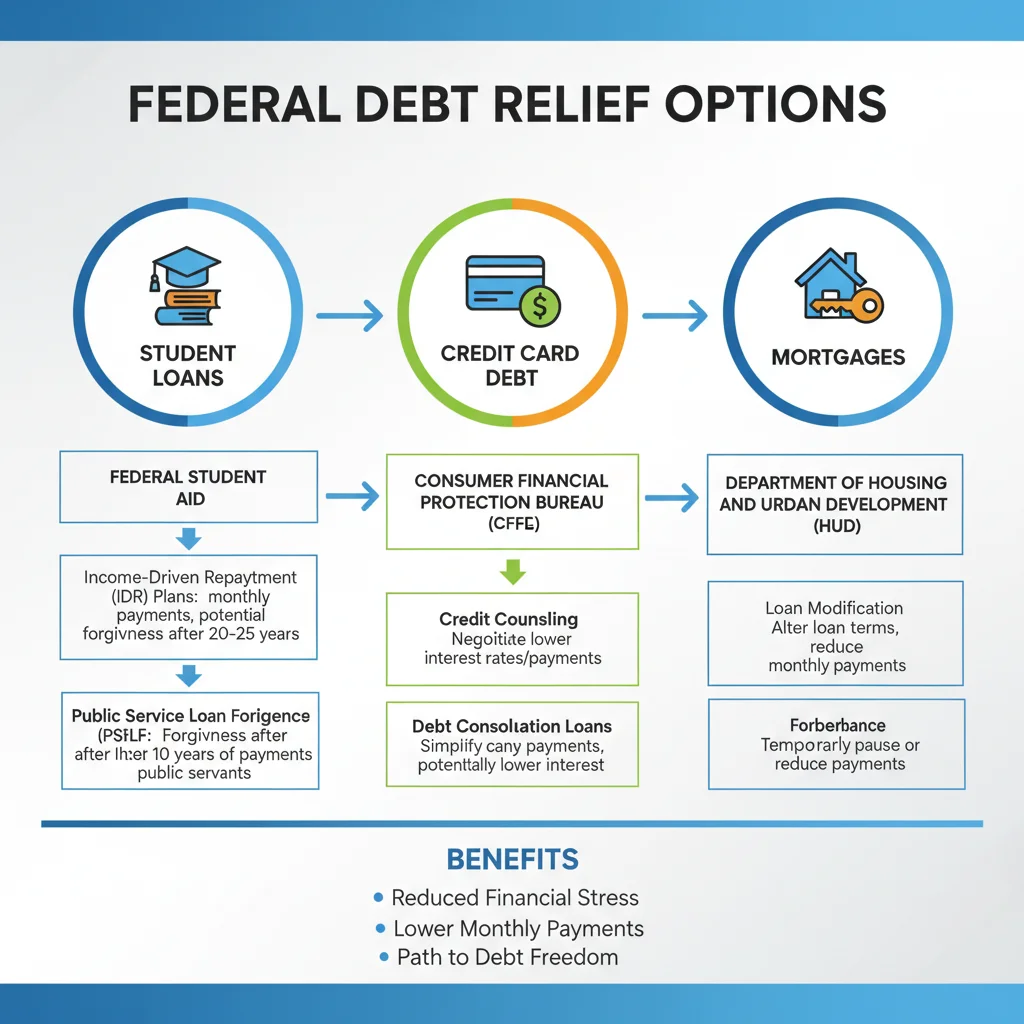
- Student Loan Debt: This remains a major concern for millions of Americans. Expect continued refinement of income-driven repayment (IDR) plans, potential for further loan forgiveness initiatives for specific professions or long-term borrowers, and possibly new mechanisms to reduce principal balances.
- Housing and Mortgage Assistance: Programs aimed at preventing foreclosures, offering mortgage forbearance, and providing rental assistance are likely to persist, especially in areas with high housing costs or economic instability. Initiatives to help first-time homebuyers or those struggling with rising interest rates might also be introduced.
- Small Business Debt: Federal support for small businesses, often through programs administered by the Small Business Administration (SBA), is crucial for economic growth. Look for continued access to low-interest loans, debt restructuring options, and grants designed to help businesses recover and expand.
- Credit Card and Consumer Debt: While direct federal relief for credit card debt is less common, indirect measures such as financial literacy programs, counseling services, and support for non-profit credit counseling agencies may be bolstered. Understanding these resources is an important aspect of navigating 2026 Debt Relief Programs.
Student Loan Relief in 2026: What to Expect
Student loan debt is a pervasive issue, and federal relief efforts in this area are often the most discussed. For 2026, borrowers should anticipate a landscape shaped by recent policy changes and ongoing debates about higher education affordability.
Income-Driven Repayment (IDR) Plans
IDR plans are a cornerstone of federal student loan relief. These plans adjust monthly payments based on a borrower’s income and family size, potentially leading to lower payments and eventual loan forgiveness after a certain period (usually 20 or 25 years). In 2026, it’s highly probable that existing IDR plans will continue, possibly with further enhancements to make them more accessible and beneficial. Keep an eye out for any new or modified IDR options that could significantly reduce your monthly burden and accelerate your path to forgiveness. Understanding the nuances of each IDR plan is vital for maximizing your benefits under 2026 Debt Relief Programs.
Targeted Forgiveness Programs
Beyond general IDR forgiveness, targeted forgiveness programs are likely to remain a focus. These often include:
- Public Service Loan Forgiveness (PSLF): For borrowers working in qualifying public service jobs, PSLF offers forgiveness of the remaining balance after 120 qualifying monthly payments. Expect continued efforts to streamline the PSLF process and address historical issues that have made it difficult for some borrowers to qualify.
- Teacher Loan Forgiveness: Teachers in low-income schools may be eligible for forgiveness of up to $17,500 on certain federal loans.
- Borrower Defense to Repayment: This program provides relief to students who were defrauded by their schools. While often retroactive, new guidelines or expanded eligibility could be introduced.
- Total and Permanent Disability (TPD) Discharge: Borrowers with a total and permanent disability can have their federal student loans discharged. Improvements to the application process and automatic discharges for certain disabled veterans are trends that may continue.
It’s crucial to regularly check the official Department of Education website for the most up-to-date information on these and other potential 2026 Debt Relief Programs related to student loans.
Potential New Initiatives
The political and economic climate leading up to 2026 could also spur new forms of student loan relief. This might include:
- Expanded Loan Forgiveness: Broader forgiveness initiatives, though often subject to significant political debate, could be introduced or expanded.
- Interest Rate Reductions: Measures to cap or reduce interest rates on federal student loans could make repayment more manageable.
- Refinancing Options: Federal programs might offer more favorable refinancing opportunities for borrowers with high-interest loans.
Staying informed about legislative proposals and government announcements will be key to understanding the full scope of student loan 2026 Debt Relief Programs.
Housing and Mortgage Assistance Programs for 2026
For homeowners and renters, federal assistance plays a vital role in preventing displacement and promoting housing stability. As 2026 approaches, expect a continued focus on programs designed to help individuals and families maintain their homes.
Mortgage Forbearance and Modification
In times of economic hardship, mortgage forbearance allows homeowners to temporarily pause or reduce their mortgage payments. While specific emergency programs may sunset, the underlying principle of offering flexibility to struggling homeowners is likely to persist. Federal agencies like the Department of Housing and Urban Development (HUD) and government-sponsored enterprises (GSEs) like Fannie Mae and Freddie Mac often have standing programs for mortgage modification, which can permanently alter loan terms to make payments more affordable. These will be integral parts of 2026 Debt Relief Programs for homeowners.
Foreclosure Prevention Initiatives
Various federal initiatives aim to prevent foreclosures by providing counseling services, financial assistance, or mediation programs. HUD-approved housing counseling agencies are invaluable resources for homeowners facing difficulties. These agencies can help you understand your options, negotiate with your lender, and connect you with available aid. Anticipate these services to remain robust in 2026, serving as a critical component of housing debt relief.
Rental Assistance Programs
For renters, federal programs like the Housing Choice Voucher Program (Section 8) provide significant assistance. While not direct debt relief in the traditional sense, these programs reduce a major monthly expense, freeing up funds that can be used to pay down other debts. Additionally, emergency rental assistance programs, which were expanded during the pandemic, may see continued or modified funding depending on economic conditions. These programs indirectly contribute to overall financial stability, making them relevant to the broader discussion of 2026 Debt Relief Programs.

Small Business Debt Relief: Supporting Economic Growth in 2026
Small businesses are the backbone of the economy, and federal programs often provide critical support to help them manage debt, recover from downturns, and grow. For 2026, the Small Business Administration (SBA) will likely remain the primary channel for such assistance.
SBA Loan Programs
The SBA offers various loan programs designed to help small businesses access capital and manage their finances. These include:
- 7(a) Loan Program: The SBA’s primary program for providing financial assistance to small businesses, offering various types of loans for working capital, equipment, and real estate.
- 504 Loan Program: Provides long-term, fixed-rate financing for major fixed assets, such as land and buildings.
- Microloan Program: Offers small loans to help small businesses and certain non-profit childcare centers start up and expand.
While not direct debt forgiveness, these programs provide favorable terms and access to capital that can help businesses manage existing debt or avoid accumulating high-interest debt. For 2026, expect these core programs to continue, with potential adjustments to eligibility or loan limits to reflect economic conditions.
Disaster Loan Assistance
The SBA also provides low-interest disaster loans to businesses, homeowners, and renters in declared disaster areas. As climate-related events become more frequent, these loans will remain a critical component of federal relief, helping businesses rebuild and recover, thus preventing insurmountable debt. Staying aware of these options is crucial for businesses located in vulnerable regions when considering 2026 Debt Relief Programs.
Counseling and Technical Assistance
Beyond direct financial aid, the SBA and its partners (such as Small Business Development Centers and SCORE) offer invaluable counseling and technical assistance. These services can help business owners develop financial strategies, manage debt, and navigate complex regulations. Access to such expert guidance can be just as important as direct financial relief in ensuring the long-term viability of a small business.
Eligibility and Application Process for 2026 Debt Relief Programs
Understanding who qualifies and how to apply is paramount to accessing federal debt relief. While specific criteria vary by program, some general principles apply across many initiatives.
General Eligibility Factors
Most federal debt relief programs consider a combination of factors:
- Income Level: Many programs are means-tested, meaning eligibility depends on your income relative to the federal poverty line or area median income.
- Debt Type: Federal programs typically address specific types of debt, such as federal student loans, FHA-insured mortgages, or SBA-guaranteed business loans. Private debt (e.g., private student loans, most credit card debt) is rarely covered by direct federal relief.
- Hardship Demonstration: You may need to demonstrate financial hardship, such as a job loss, significant medical expenses, or reduced income, to qualify for certain forbearance or modification programs.
- Residency/Citizenship: Most federal programs require U.S. citizenship or eligible immigration status.
- Compliance History: For some programs, a history of compliance with previous loan terms or tax obligations may be considered.
It is essential to review the specific eligibility requirements for each program you are interested in. Do not assume you are ineligible without thoroughly checking the criteria for 2026 Debt Relief Programs.
The Application Process: Step-by-Step Guidance
The application process can vary significantly depending on the program. However, a general outline often includes:
- Research and Identify Programs: Start by identifying which 2026 Debt Relief Programs align with your debt type and financial situation. Official government websites (e.g., Department of Education, HUD, SBA) are the best sources of information.
- Gather Required Documentation: You will likely need to provide documentation such as proof of income (pay stubs, tax returns), statements for all your debts, identification, and potentially hardship letters.
- Complete the Application: Many applications can now be completed online, but some may require mailed forms. Follow instructions carefully and fill out all sections accurately.
- Submit Supporting Documents: Ensure all required supporting documents are submitted along with your application. Missing information is a common cause of delays or rejections.
- Follow Up: After submission, it’s wise to follow up to confirm receipt and check the status of your application. Keep records of all communications.
- Seek Counseling: For complex situations, consider consulting with a non-profit credit counselor or housing counselor. They can provide personalized advice and help you navigate the application process.
Timeliness is often critical, especially for programs with limited funding or application windows. Begin your research and preparation early for any 2026 Debt Relief Programs.
Preparing for 2026 Debt Relief: Proactive Steps You Can Take Now
Even before 2026 arrives, there are proactive steps you can take to put yourself in the best position to benefit from any new or existing debt relief programs.
Assess Your Current Financial Situation
The first step is to get a clear picture of your current financial health. This involves:
- Inventorying All Debts: List all your debts, including creditors, outstanding balances, interest rates, and minimum monthly payments.
- Tracking Income and Expenses: Create a detailed budget to understand where your money is coming from and where it’s going.
- Checking Your Credit Report: Obtain free copies of your credit report from the three major bureaus (Experian, Equifax, TransUnion) to ensure accuracy and understand your credit score.
A thorough assessment will help you identify which types of debt are most burdensome and which 2026 Debt Relief Programs might be most relevant to your situation.
Improve Your Financial Literacy
Understanding personal finance is a powerful tool. Educate yourself on topics like budgeting, saving, investing, and debt management. Many free resources are available online, through non-profit organizations, and at local libraries. The more financially literate you are, the better equipped you’ll be to make sound decisions and leverage available relief.
Build an Emergency Fund
Even a small emergency fund can provide a buffer against unexpected expenses, reducing the likelihood of falling further into debt. Aim to save at least three to six months’ worth of essential living expenses, if possible. This financial cushion can be invaluable, whether or not you qualify for 2026 Debt Relief Programs.
Communicate with Creditors
If you’re already struggling, don’t wait until 2026 to act. Contact your creditors directly. Many are willing to work with you to create a more manageable payment plan, temporarily reduce interest rates, or offer forbearance options. Being proactive can prevent your debt situation from worsening and demonstrate a good faith effort, which can be beneficial if you later apply for federal relief.
Common Misconceptions About Federal Debt Relief
It’s important to dispel common myths and misunderstandings surrounding federal debt relief to ensure you have accurate expectations.
Myth 1: All Debt Will Be Forgiven Automatically
Reality: While some targeted forgiveness programs exist, and IDR plans can lead to forgiveness, it’s rarely automatic or universal. Most programs require active application, meet specific eligibility criteria, and often involve a period of repayment before forgiveness is granted. The idea of widespread, automatic forgiveness for all types of debt is generally a misconception when discussing 2026 Debt Relief Programs.
Myth 2: Debt Relief is a ‘Get Out of Jail Free’ Card
Reality: Debt relief programs are designed to provide assistance to those genuinely struggling, but they are not without consequences or responsibilities. Loan modifications can extend repayment terms, and some forgiven debt might be considered taxable income. It’s crucial to understand the full implications of any program you consider.
Myth 3: Private Debt is Covered by Federal Programs
Reality: Federal debt relief programs almost exclusively apply to federal loans and federally backed debts (e.g., federal student loans, FHA/VA/USDA mortgages). Private student loans, most credit card debt, and personal loans are generally not eligible for direct federal relief. For these, you’ll need to explore options like debt consolidation, credit counseling, or negotiation with private lenders. Always distinguish between federal and private debt when researching 2026 Debt Relief Programs.
Myth 4: Debt Relief Will Ruin Your Credit Score
Reality: The impact on your credit score varies. While bankruptcy or default will significantly harm your score, many federal relief options, like income-driven repayment or mortgage forbearance, are designed to help you avoid default and can, in fact, protect or even improve your credit over time by helping you make consistent payments. However, any modification to loan terms can be reported to credit bureaus, so understanding the specific impact of a program is important.
Where to Find Official Information and Support
Relying on accurate, official sources is paramount when seeking information about 2026 Debt Relief Programs. Beware of scams or predatory companies that promise guaranteed relief for a fee.
Official Government Websites
- U.S. Department of Education: For federal student loan information (studentaid.gov).
- U.S. Department of Housing and Urban Development (HUD): For housing and mortgage assistance (hud.gov).
- Small Business Administration (SBA): For small business loans and assistance (sba.gov).
- Consumer Financial Protection Bureau (CFPB): For consumer finance information and resources (consumerfinance.gov).
Non-Profit Counseling Services
Reputable non-profit organizations offer free or low-cost financial counseling. These include:
- National Foundation for Credit Counseling (NFCC): Provides certified credit counseling and debt management plans.
- HUD-Approved Housing Counseling Agencies: Offer specialized advice for homeowners and renters.
- SCORE: Mentors for small business owners.
These organizations can provide unbiased advice and help you navigate the complexities of 2026 Debt Relief Programs.
Conclusion: Empowering Your Financial Future with 2026 Debt Relief Programs
The prospect of 2026 Debt Relief Programs offers a beacon of hope for many struggling with financial obligations. While the specific details of these initiatives will continue to unfold, a proactive and informed approach is your best strategy. By understanding the potential areas of federal focus—student loans, housing, and small business support—and by taking steps to improve your financial literacy and prepare your documentation, you position yourself to effectively leverage the aid available.
Remember that debt relief is not a magic bullet, but a tool to help you regain control over your financial life. It requires diligence, careful planning, and a commitment to understanding the terms and conditions of any program you engage with. Always rely on official government sources and reputable non-profit organizations for guidance. By doing so, you can confidently navigate the landscape of federal assistance and work towards a more stable and prosperous financial future in 2026 and beyond.
Stay vigilant for updates, consult with experts when necessary, and take control of your financial narrative. The journey to debt relief may be challenging, but with the right information and resources, it is a journey you can successfully complete.